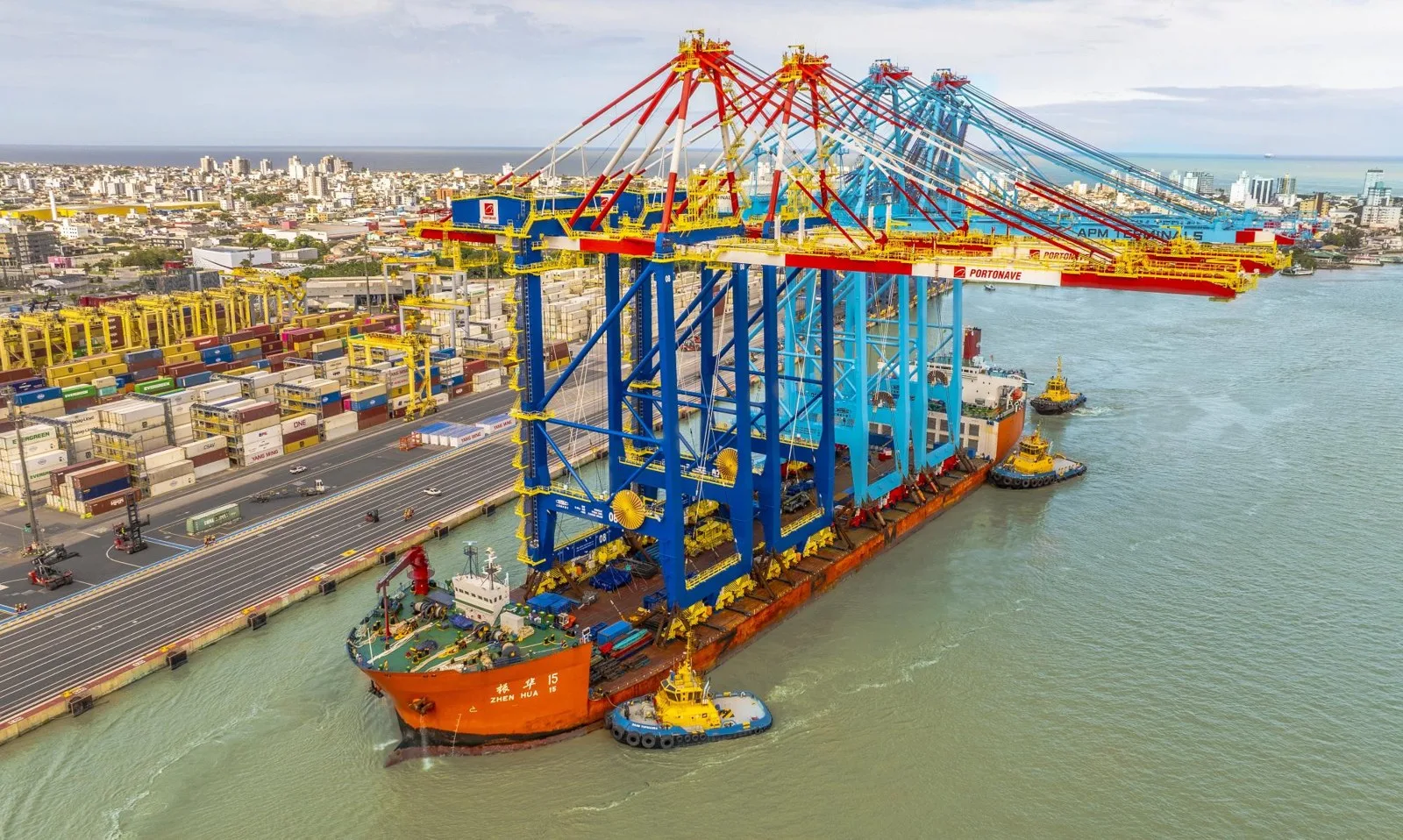
Portonave, the container terminal at Navegantes in the Brazilian state of Santa Catarina, received two new electric ship-to-shore (STS) container cranes on 14 November 2026. They were built by China's ZPMC and arrived from Shanghai on the heavy-lift vessel Zhen Hua 15, which sailed on 21 September. The pair cost the terminal BRL 229 million, about 40 million US dollars.
The cranes
| Item | Value |
|---|---|
| Builder | ZPMC (China) |
| Number | 2 |
| Drive | electric |
| Crane height | 55 m |
| Lifting capacity | up to 100 t |
| Vessels | up to 400 m long |
| Commissioning | by 31 December 2026 |
The terminal has not given the outreach, that is, how many container rows across a ship the cranes can reach. Before they go into service the cranes will be tested and staff trained on their automation systems.
The new cranes stand out from the rest of the quay fleet: their booms are red and white. According to Latin American trade press, this is an aviation safety requirement, since the terminal sits close to Navegantes international airport and tall structures near the runway have to be clearly visible to pilots.
How an STS crane works
An STS crane is a rail-mounted gantry running along the quay edge. A long boom reaches out over the ship, and a trolley carrying a spreader, the device that grips the container, travels along it. When a ship berths the boom is lowered to the horizontal over the vessel; afterwards it is raised to clear the way for shipping. The wider the ship, the longer the boom and the taller the gantry have to be, which is why quay cranes have grown with container ships.
Why the terminal needs them
Portonave, Brazil's first private container terminal, opened in 2007 and is operated by Terminal Investment Limited (TiL). At present up to six STS cranes can work the quay at once. The terminal is finishing a rebuild of the quay, strengthening it and deepening the berth to 17 m so it can take ships up to 400 m long; the work is due to be completed in the fourth quarter of 2026.
Once the whole investment programme is complete, Portonave will have eight STS cranes and 32 rubber-tyred gantry (RTG) cranes in the yard, with every new machine electric; seven of the 14 electric RTGs it ordered arrived earlier in 2026. Annual capacity is set to rise from 1.5 million to 2 million TEU, an increase of about a third.
Source: Portonave