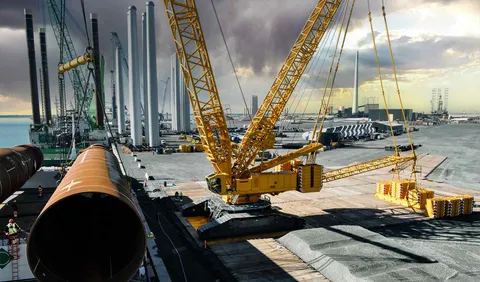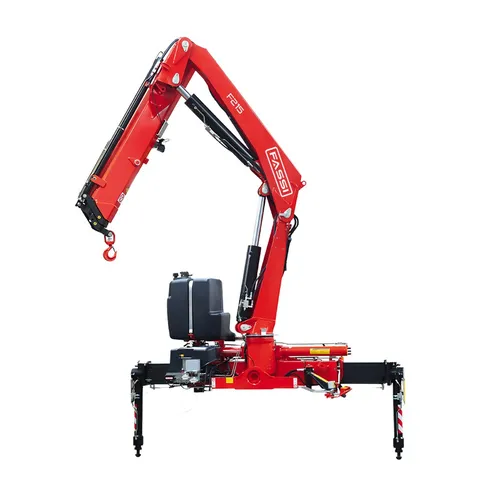
Every quayside crane does the same basic job – moving cargo between ship and shore – but three very different machines do it. A mobile harbour crane drives along the quay on wheels. A portal crane runs on rails and lets trucks and trains pass beneath it. A ship-to-shore gantry is a giant frame built around a flow of containers. The choice depends on the cargo, the throughput and how much a port is prepared to invest in its quay.
Mobile harbour cranes
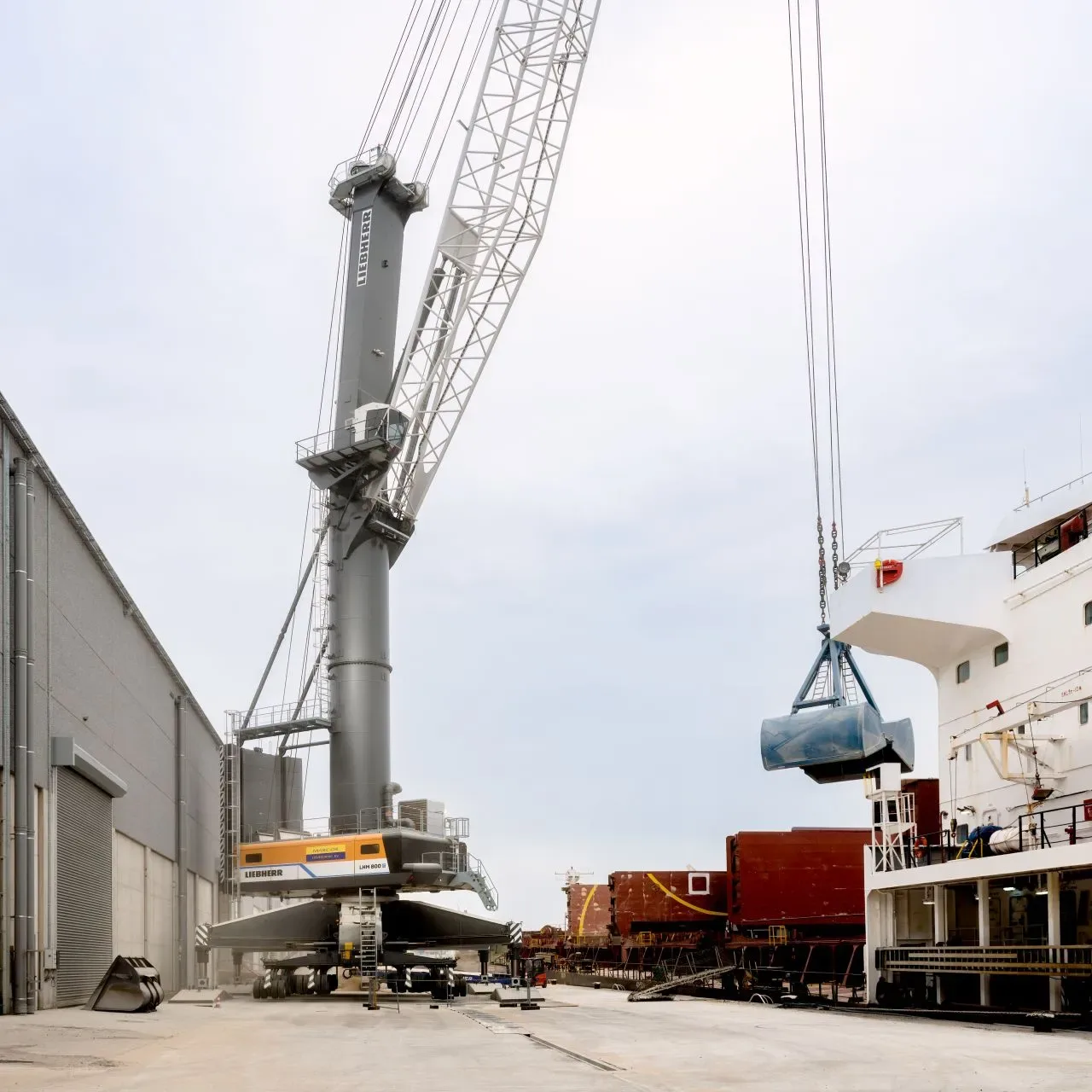
A mobile harbour crane is a slewing tower and boom on a multi-axle wheeled carrier. It drives itself between berths and works on four outriggers. It needs no rails or continuous heavy foundations along the quay, which makes it a natural fit for smaller, multi-purpose ports handling grain one day, containers the next and a transformer the day after.
The leading manufacturers are Liebherr with its LHM range and Konecranes with the Gottwald brand. Their ranges show the spread:
| Model | Max capacity | Max radius | Vessels (per manufacturer) |
|---|---|---|---|
| Konecranes Gottwald ESP.4 | 100 t | 42 m | small sea and river ports |
| Konecranes Gottwald ESP.6 | 125 t | 49 m | Panamax |
| Konecranes Gottwald ESP.8 | 150 t | 54 m | Post-Panamax |
| Konecranes Gottwald ESP.10 | 125 t | 64 m | Super Post-Panamax |
| Liebherr LHM 800 | 308 t | 64 m | container ships up to 22 rows wide |
As with construction mobile cranes (see "Why a 150 tonne crane rarely lifts 150 tonnes"), maximum capacity and maximum radius do not coincide: the LHM 800 lifts 308 tonnes only out to 16 metres, and around 114 tonnes at 40 metres. Two cranes can work in tandem, taking the LHM 800 to 616 tonnes.
The strengths are versatility and a lower entry cost. The weaknesses are lower container productivity than a dedicated gantry, and outriggers that take up quay space.
Portal cranes
A portal crane is a slewing crane mounted on a tall gantry, or portal, that travels on rails along the quay. Rail tracks and roadways pass beneath it, so cargo can be loaded straight into wagons.
Most portal cranes use a four-link, level-luffing jib: a linkage keeps the hook at the same height as the radius changes, so the load travels horizontally without the operator having to work the hoist at the same time. It is the same principle as level luffing on luffing jib tower cranes, achieved mechanically. Simpler single-jib portal cranes also exist; they are lighter but the hook rises and falls as the jib luffs.
Portal cranes are the workhorses of bulk and general cargo – coal, ore, steel and timber. Typical capacities run from 5–10 tonnes to several tens of tonnes, with a grab or hook, at radii of up to 40–50 metres. They are built for decades of continuous duty, but are tied to their berth by rails, power supply and foundations.
Ship-to-shore cranes
A ship-to-shore (STS) crane is a rail-mounted gantry with a long boom reaching out over the vessel. A trolley carrying a spreader – the container grab – runs along the boom. There is no slewing: the crane moves along the quay, the trolley across the ship.
The key figure is not tonnage but outreach – how many container rows across the ship the crane can reach. The first dedicated container crane, built for Matson in 1958, had an outreach of 23.8 metres. Today's cranes for the largest container ships are specified for 24 to 26 rows and outreaches beyond 60 metres, with lift heights of around 50 metres above the quay.
The market is highly concentrated: China's ZPMC says it builds around 70 per cent of the world's STS cranes. Other suppliers include Liebherr, Konecranes, Paceco and Mitsubishi.
STS cranes are the most productive option for containers, and the most expensive: they need a reinforced quay and heavy power supply, and pay off only with large, steady volumes.
How ports choose
- Mixed cargo, moderate volumes, no quay rails – a mobile harbour crane, which can be moved to another berth or resold.
- Bulk and general cargo, steady high volumes, direct loading to rail – a portal crane.
- Container terminal with large ships – STS cranes at the quay, with rubber-tyred or rail-mounted gantries (RTG and RMG) in the stacking yard.
Many ports combine types. A mobile crane is often the first step: a port builds container volumes with it, then installs STS cranes once traffic justifies a dedicated terminal. In Bermuda, for example, the stevedoring company is replacing its 2011 mobile crane in 2027 with a new one rated 40 tonnes higher – without building a new berth. The Port of Matarani in Peru has ordered a 125 tonne ESP.6.
What else works in ports
Floating cranes, ship's cranes – mounted on vessels so they can unload where there is no shore equipment – and yard cranes such as RTGs and RMGs are beyond the scope of this article. We will return to them separately.