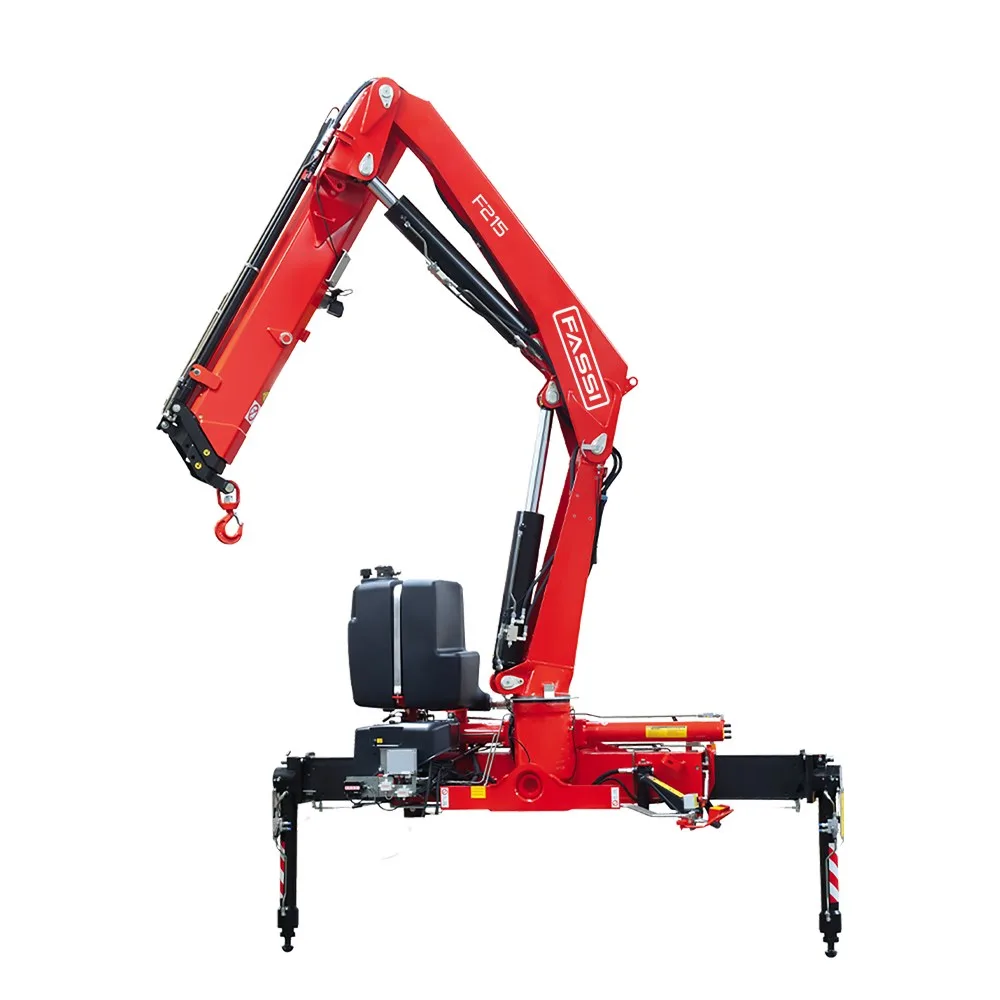
The loader crane – the knuckle boom crane on the back of a truck – is the most common crane there is, and the largest section of our catalogue with around 1,250 models. It is also the crane most often chosen by the wrong number. This guide sets out which figures actually decide whether a crane will do the job.
Lifting moment, not tonnes
The defining figure for a loader crane is its lifting moment: load multiplied by outreach, quoted in tonne-metres (tm) or kilonewton-metres (kNm). One tonne-metre is about 9.8 kNm.
The headline tonnage is the maximum close to the crane column. Palfinger's PK 23500, for example, is rated by the manufacturer at a 10 tonne maximum capacity and a 23 tm lifting moment. Ten tonnes is possible only at around 2.3 metres; one published chart for the crane gives 4.7 tonnes at 4.6 metres, 3.4 tonnes at 6.1 metres and 2.5 tonnes at 8 metres.
That is why loader cranes are compared by moment, which most manufacturers build into the model name: around 20 tm for the Fassi F215A, 23 tm for the PK 23500.
The logic is the same as for large mobile cranes, covered in our article "Why a 150 tonne crane rarely lifts 150 tonnes". How to work with the chart itself is explained in "How to read a crane load chart".
Extensions: reach against capacity
The same crane is usually offered with different numbers of hydraulic extensions, often shown by the last digit of the model code. Fassi's F215A.0 range shows the trade-off clearly (manufacturer's data):
| Model | Max. outreach | Lifting moment | Crane weight |
|---|---|---|---|
| F215A.0.21 | 6.30 m | 20.1 tm | 2,005 kg |
| F215A.0.22 | 8.30 m | 18.9 tm | 2,180 kg |
| F215A.0.23 | 10.40 m | 18.1 tm | 2,355 kg |
| F215A.0.24 | 12.55 m | 17.8 tm | 2,505 kg |
| F215A.0.25 | 14.65 m | 17.5 tm | 2,625 kg |
Each extension adds about two metres of reach, but its own weight lowers the lifting moment and adds 150 to 200 kg to the crane. At the tip the loads become small: 1,220 kg at 12.3 metres horizontal outreach for the F215A.0.24, against 2,315 kg at 8 metres for the F215A.0.22.
The practical rule is to buy the extensions your regular work needs, not extra "just in case". Every unused section costs capacity at medium reach and payload on the truck bed.
Fly jibs
A fly jib is a second articulated boom on the end of the main one. It adds height and reach and lets the operator place loads over obstacles or through openings; on the F215A.0 it takes maximum outreach from 14.65 to 23.6 metres. The price is weight: the crane gets several hundred kilograms heavier, while capacity at long reach drops to a few hundred kilograms. Manual extensions also reduce permitted loads by their own weight, as manufacturers note on their charts.
Knuckle boom or winch
In Western Europe the standard loader crane carries its hook on the boom tip and lifts by moving the boom itself. In the former Soviet market, winch-equipped loader cranes with a wire rope are also common – for example the Galichanin KMU-150 from Galichskiy avtokranovyy zavod (Galich Truck Crane Plant), built since 2017, and Palfinger's Inman IT 150, rated by the manufacturer at up to 7 tonnes and 19 metres. A winch suits lowering loads below the truck or hoisting high on the hook; a knuckle boom is faster and more precise for loading and installation work, especially with attachments.
The truck
A loader crane is only half the machine, and many limits come from the truck.
Position
Most cranes go behind the cab, which suits the chassis and allows work on both sides; rear mounting leaves more bed space behind the cab but changes the weight distribution. A mid-range crane needs around 0.9 metres of chassis length – 0.88 metres for the PK 23500.
Weight and axles
A 20 tm crane weighs 2 to 2.6 tonnes that the bed can no longer carry. Check front axle load, especially with behind-cab mounting, and the vehicle's gross weight. Our article on axle loads covers road limits in more detail.
Stabilisers
Load charts assume a given stabiliser spread – 4.8 metres standard and 6.6 metres maximum on the PK 23500. On a tight site the legs may not extend fully, and a reduced chart applies. Modern control systems read actual stabiliser positions and slew angle.
Hydraulics
The crane needs a power take-off and pump matching its flow – typically 45 to 75 litres per minute in the 20 tm class. This is a question for the body builder, but worth asking.
Controls and safety
Basic cranes have levers on both sides of the truck. Options include a raised seat on the column, with a view of the load above the bodywork, and radio remote control, which lets the operator stand where the load lands – often worth the cost on delivery and installation work.
European standard EN 12999 requires a rated capacity limiter on loader cranes with a rated capacity from 1,000 kg or a lifting moment from 40 kNm; simpler protection is allowed on lighter units. Outside the EU, check national rules.
Questions to answer first
- What is the heaviest load, and at what outreach must it be placed? That sets the moment class.
- What is the longest outreach used regularly, and with what load? That decides extensions and whether a jib is needed.
- Must loads go below truck level or very high? If so, consider a winch crane.
- Is there room on site for full stabiliser spread?
- Which truck, and how much payload is left once the crane is fitted?
- Who operates it – is remote control or a raised seat needed?
The answers narrow hundreds of models to a handful. Compare those using their load charts at your real outreaches, not the numbers in their names.
This article is for reference only. It does not replace the manufacturer's documentation, the body builder's mounting calculation or the regulations that apply in your country.