Most tower cranes on building sites have a horizontal jib with a trolley running along it – flat tops or hammerheads. In old city centres and on sites where several cranes work side by side, however, a growing share are luffing jib cranes, or luffers. Here is how they differ, when they make sense and what the trade-offs are. For general advice on choosing a tower crane, see "How to choose a tower crane for a construction site".
How it works
On a trolley-jib crane the radius changes as the trolley moves along a jib that always stays horizontal. When it slews, the jib sweeps a full circle with a radius equal to its length: a 60 metre jib covers a circle 120 metres across.
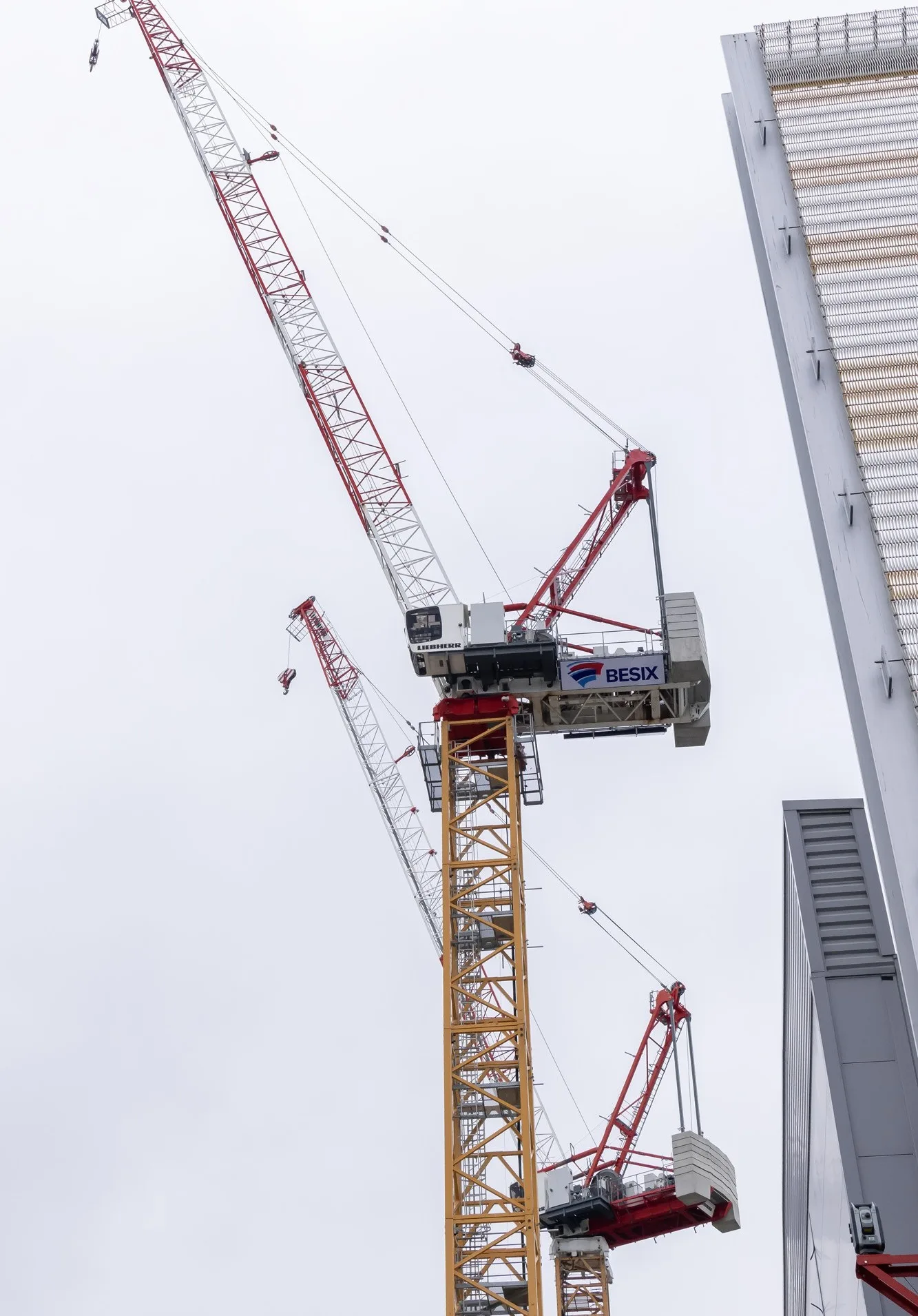
A luffer has no trolley. The load hangs from the jib tip and radius is changed by raising or lowering the jib. Modern luffers use level luffing: the control system pays out or reels in hoist rope so that the load moves horizontally rather than along an arc as the radius changes.
The key consequence is that with the jib raised close to vertical, the crane takes up very little space in plan.
The out-of-service radius
When a tower crane is out of service – overnight, at weekends or in high winds – the slew brake is released so it can weathervane freely. A trolley-jib crane then sweeps its full jib length. If neighbouring buildings, a school or a street fall within that circle, the jib passes over them with nobody at the controls.
A luffer weathervanes with its jib raised, so the radius shrinks dramatically. Manufacturer figures include:
- Liebherr 357 HC-L – 17.4 metres with a 50 metre jib, the jib rising to more than 70 degrees;
- Potain MR 229 – 10 or 12 metres depending on jib length, with a minimum of 10.25 metres;
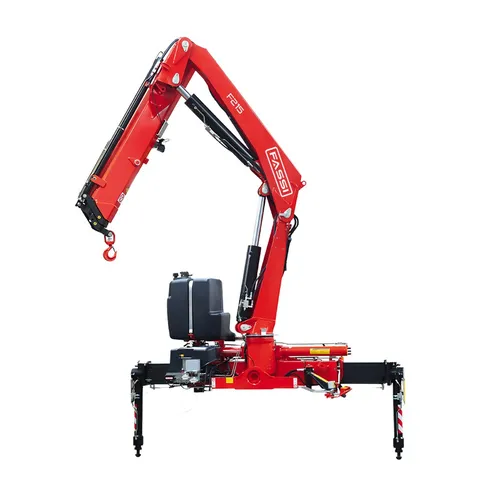
- small hydraulic luffers and articulated cranes – down to around 4 metres.
By contrast, a flat top with a 45 metre jib sweeps a 45 metre radius, plus the counter-jib on the other side.
In many countries oversailing a neighbour's property needs the owner's consent; in the UK, for example, it can amount to trespass on airspace. In dense urban areas a trolley-jib crane may simply not be permitted.
Several cranes on one site
The second scenario is a site with overlapping crane zones. Trolley-jib cranes are staggered in height so that the lower one works beneath the jib of the higher one, with anti-collision systems keeping them apart. That is the approach on the Mistral development in Marseille, where five Potain MDT cranes have hook heights ranging from 42 to 61 metres.
Luffers can stand closer together with less height difference, since a raised jib clears its neighbour. A short counter-jib also helps: on the Liebherr 357 HC-L the tail slewing radius is 7.5 metres.
Height without extra tower
A raised jib adds hook height without extra tower sections. That is why luffers have traditionally worked on high-rise buildings, with the largest models climbing with the structure, tied to floors or inside cores. For this kind of installation the 357 HC-L offers a tower just 1.9 by 1.9 metres in section, suitable for use inside the building or on its facade.
How they compare
| Model | Type | Max capacity | Max radius | Tip load |
|---|---|---|---|---|
| Liebherr 357 HC-L 18/32 | luffing jib | 32 t | 60 m | 4.1 t |
| Wolff 355 B | luffing jib | 28 t | 60 m | 4 t |
| Potain MR 229 | luffing jib | 14 t | 55 m | 2.7 t |
| Potain MDT 319 | flat top | 12 t | 70 m | 3.2 t |
Figures are from the manufacturers. Maximum capacity applies only at short radius: the 357 HC-L 18/32 lifts 32 tonnes in two-fall reeving up to 18.2 metres, or 18 tonnes in single fall up to 33.9 metres.
Luffers in the same class generally offer higher maximum capacity, since the jib works mainly in compression and the load chart is fuller. Flat tops win on maximum radius.
The trade-offs
- Cost and complexity. As well as the hoist winch, a luffer needs a powerful luffing winch, jib reeving and a level-luffing system. It costs more to buy and rent and is more demanding to maintain.
- Cycle speed. Changing radius by luffing is usually slower than moving a trolley. On concrete work with frequent short cycles a trolley-jib crane is often more productive.
- Power. Luffing raises the whole jib, not just the load, so luffers draw more electricity – a factor if the site runs on a generator.
- Erection. The jib takes longer to assemble and reeve, and the out-of-service position must be planned for storm conditions.
- Minimum radius. A luffer cannot work very close to its own tower, as the jib reaches its limiting angle. A trolley brings the load closer to the mast.
Which to choose
A luffer makes sense:
- next to buildings, roads or railways that the jib must not oversail, or where consent to oversail is costly;
- on sites with three or more cranes and overlapping zones;
- on high-rise projects where the crane climbs with the building;
- when heavy loads are needed at medium radius in a confined space.
A trolley-jib crane is the better choice:
- on open sites where the slewing circle troubles no one;
- when long reach with moderate loads is needed;
- for work with frequent short cycles, such as placing concrete by skip;
- when rental cost and simple erection matter most.
In practice the site plan often decides before the load chart does: if the slewing circle extends beyond the site boundary, the choice of a luffer is made before any loads are calculated. UK contractor Mayo Civil Engineering, for one, runs an all-luffer fleet and has just ordered eight more Wolff B series cranes; the first are working alongside other cranes on a tight site in Manchester.