The lattice boom crawler is the workhorse of the heaviest lifts on land – wind farms, refineries, nuclear plants and bridges. Models in the class run from 300 to 3,000 tonnes, yet they follow the same basic pattern: a bigger crane lifts more mainly because it can hold more counterweight further back.
The main parts
Undercarriage
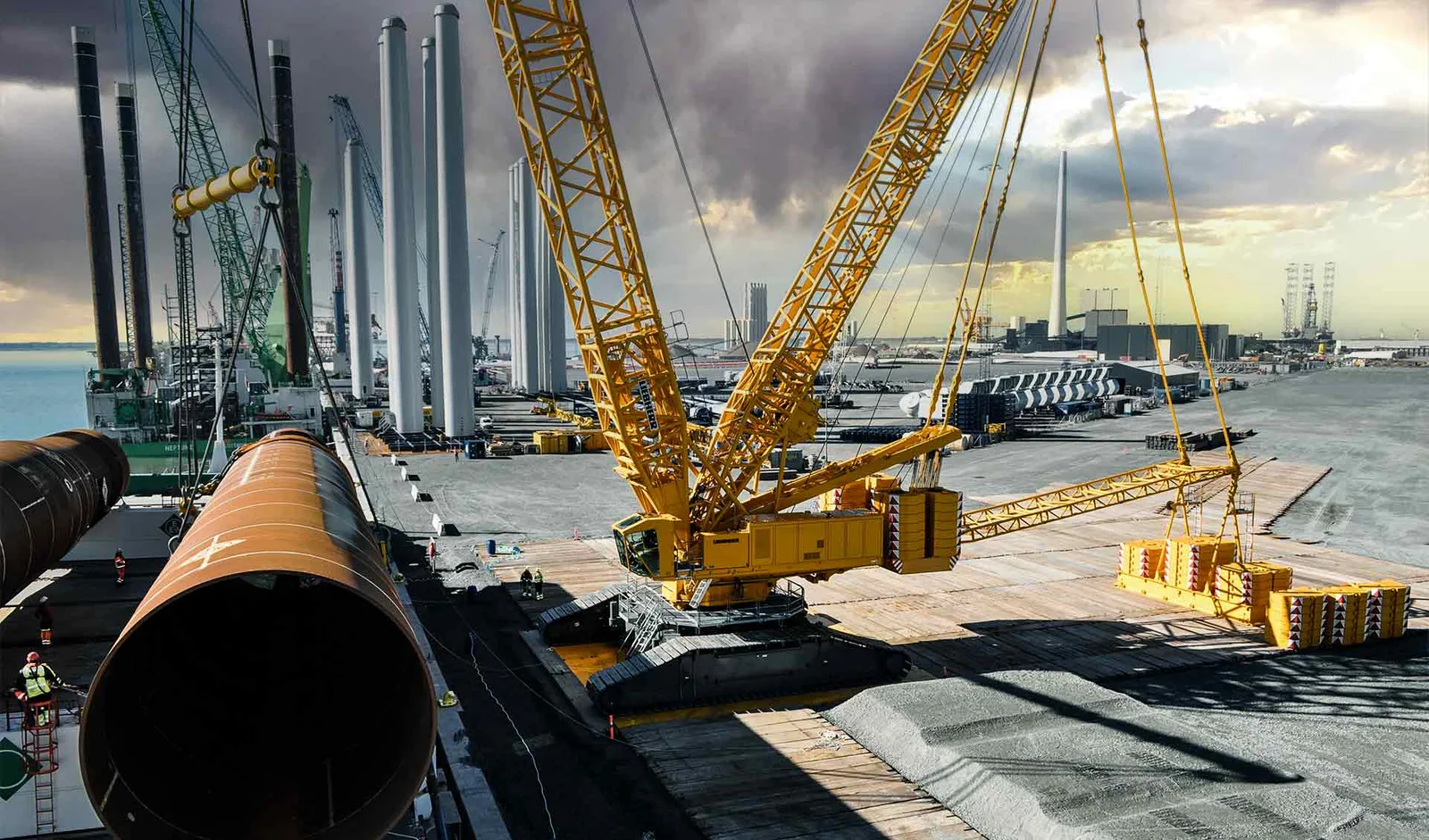
Two crawler tracks and a carbody that carries central ballast – 95 tonnes on the Liebherr LR 1750/2. A wide track gauge and large track area spread the weight, so the crane can travel with load and needs no outriggers.
Superstructure
Cab, winches, engine and main counterweight, which runs to hundreds of tonnes: 245 tonnes on the LR 1750/2, 340 on the LR 11350 and up to 750 on the LR 13000.
Lattice boom
Built up from sections on site, with a fixed jib or luffing jib added for reach and height.
Why counterweight decides everything
A crane is a lever. The load tries to tip it forward and the counterweight resists, with the resisting moment set by both the weight and its distance behind the slewing centre. Superstructure counterweight cannot simply get heavier or move further back: the superstructure has to slew. Heavy cranes therefore add a second, remote counterweight.
Derricks and superlift
A derrick is a short second lattice mast behind the main boom, mounted on the superstructure. Additional counterweight hangs from its tip, often called superlift ballast. It sits tens of metres behind the crane and slews with it, either suspended or on a ballast trailer.
| LR 1750/2 | LR 11350 | LR 13000 | |
|---|---|---|---|
| Maximum capacity | 750 t | 1,350 t at 12 m | 3,000 t at 12 m |
| Maximum load moment | – | 22,748 tm | 65,000 tm |
| Superstructure counterweight | 245 t | 340 t | 750 t |
| Central ballast | 95 t | 30 t | 150 t |
| Derrick boom | up to 38.5 m | 42 m | 54 m |
| Derrick ballast | 400 t | 600 t | 1,500 t |
Derrick ballast is one and a half to two times the main counterweight. On the LR 13000 its radius can be varied steplessly from 20 to 30 metres, and a self-propelled modular trailer can replace the suspended ballast.
Note where the maximum ratings apply: 12 metres radius, not the 2 to 3 metres quoted for mobile cranes. Thousand-tonne loads are never compact.
The derrick has a cost. The crane needs a large, prepared, unobstructed circle behind it – often the deciding constraint on a congested site.
Moving counterweight instead
Manitowoc took a different route with its Variable Position Counterweight (VPC). The counterweight travels along the superstructure and automatically moves back or forward according to load, boom length and radius, removing the need for carbody ballast and reducing total counterweight. The VPC-MAX attachment adds a fixed 30 metre (98.4 ft) beam to take the weight further back while keeping it off the ground. Manitowoc reports that a 31000 with the system lifted a 670 tonne tower at a refinery in Ulsan, South Korea, with just 15 metres of space available for the counterweight.
Booms for wind
As turbines grow, booms are being stiffened. Liebherr's SX system for the LR 1750/2 inserts two or three extra-wide lattice sections – 3.5 or 6 metres wide and 14 metres long – into the lower main boom for lateral rigidity, allowing hub heights of up to 166 metres. XCMG's 1,300 tonne XLC18000M handles turbines up to 10 MW at 142 metres on its standard 150 + 8 metre wind boom without superlift, and up to 15 MW on a 198 + 8 metre boom with it. Working without a derrick speeds moves between turbine positions.
Classes and examples
| Class | Examples | Typical work |
|---|---|---|
| 300 t | Liebherr LR 1300.1 SX, Manitowoc MLC300 | bridges, industrial erection, wind farm assist crane |
| 600–800 t | Liebherr LR 1750/2, Sany SCC8000A | wind, bridge spans, petrochemicals |
| 1,000–1,350 t | Liebherr LR 11350, XCMG XLC18000M | large turbines, reactors, columns |
| 3,000 t | Liebherr LR 13000 | nuclear plants, columns up to 1,500 t, shipbuilding |
When a load is heavier than any available crane, cranes work in tandem. In Melbourne in 2026, two 800 tonne Sany SCC8000As jointly lifted an 864 tonne bridge span that neither could have handled alone.
Transport and erection
- Component weights. No LR 11350 component exceeds 45 tonnes at 3.5 metres wide; the LR 13000's heaviest part is 70 tonnes, and the crane weighs around 3,500 tonnes in operation.
- Time. The first LR 13000, at Mammoet, reportedly took 12 days to erect. Builders of 1,000 tonne wind cranes now claim two to three days for erection or dismantling.
- Ground. Despite large track areas, the crane needs level, prepared ground; current models display ground pressure to the operator in real time.
What to compare
- Load moment and the chart for the configuration you need – with and without a derrick, a crane can be two different machines.
- Space behind the crane for derrick ballast, or the case for moving counterweight.
- Boom options: height and tip load for wind, mid-radius capacity for industry.
- Logistics: truckloads, heaviest component, erection time.
- Ground bearing pressure in the working configuration.
Our articles "Why a 150 tonne crane rarely lifts 150 tonnes" and "Choosing a crane by its carrier" cover load charts and crane types in more detail.
This article is for reference only. It does not replace the manufacturer's documentation or a lift plan.