Two cranes with the same rated capacity can be entirely different machines. One drives in on the motorway, works for two hours and leaves for the next job. The other arrives on ten trailers, takes a week to rig and stays for six months. The difference is the carrier, and that is where selection should start.
Three questions first
How often will the crane move – daily, monthly or once per project? What will it travel on at site – tarmac, prepared hardstanding or open ground? And does it need to travel with a load on the hook? The answers point almost directly to a carrier type.
Truck cranes
A crane superstructure on a commercial or purpose-built truck chassis. In much of the former Soviet region this remains the most common mobile crane, typically 25 to 50 tonnes on three or four axles. Truck cranes travel like lorries and are cheap to buy and maintain. They work only on outriggers, and off-road ability is that of the truck.
All Terrain cranes
A purpose-built multi-axle carrier with all-wheel steering, several driven axles and hydropneumatic suspension. The range runs from three axles to eight or nine: the Grove GMK3060L-1 carries 60 tonnes on three, the Liebherr LTM 1150-5.4 150 tonnes on five, and the Liebherr LTM 1450-8.1 450 tonnes on eight with an 85 metre boom.
All Terrains combine road speed with site mobility and long booms, which is why rental fleets are built around them. The price is cost and complexity, counterweight that often travels separately, and axle loads that need permits in many countries.
A sub-type is the single-cab city crane, such as the 50 tonne Liebherr LTC 1050-3.1 – shorter and lower, for factory halls and tight yards.
Rough terrain cranes
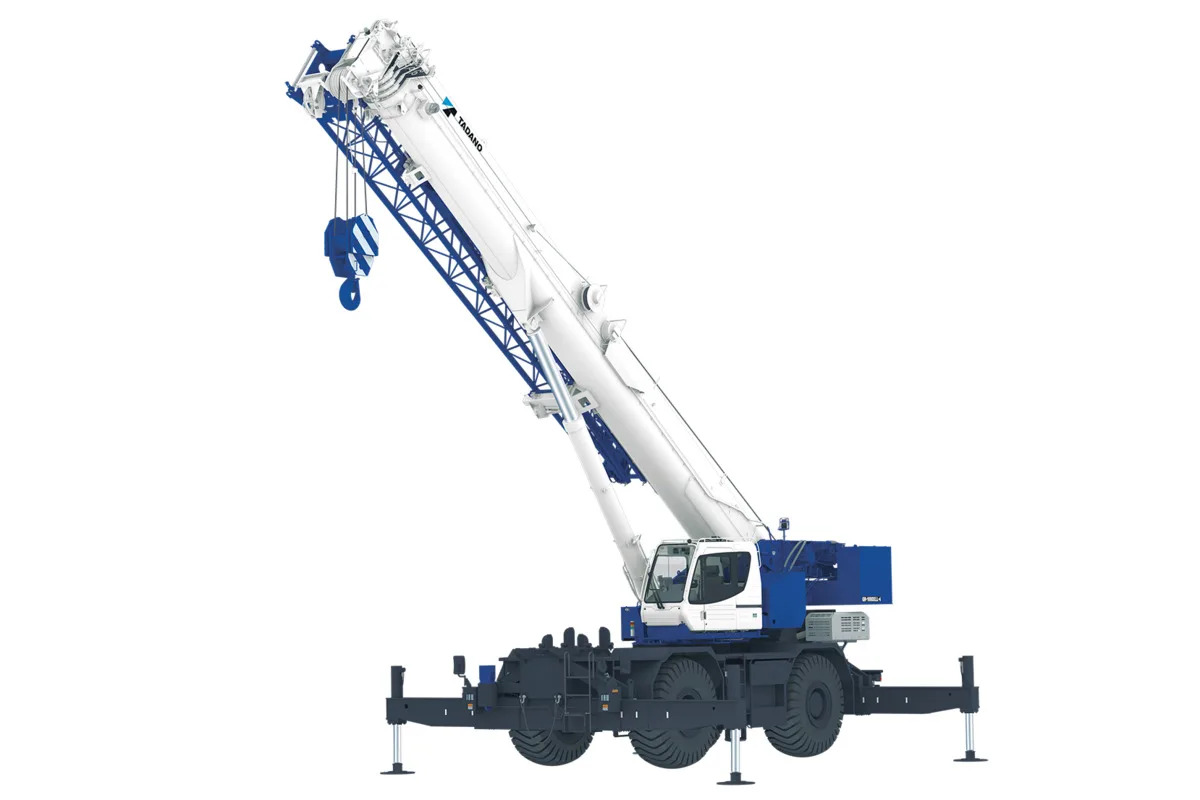
Two axles, large tyres, one cab, all-wheel drive. Rough terrains are generally not road-legal and are trailered to site, where they cope with unprepared ground, can lift on tyres and can travel with a load within their chart. The Tadano GR-1000XLL-4, a 100 US ton (about 90 tonne) model, is typical. They suit long stays on a single site: energy and process plants, mines, remote construction.
Lattice crawler cranes
The heavy-lift standard. The boom is assembled from sections and the crane travels in pieces. Examples range from the 400 tonne Liebherr LR 1400 SX to the 2,500 tonne LR 12500-1.0. Crawlers offer the highest capacities and heights, need no outriggers, travel with load and spread their weight over a large area. Mobilisation takes days and the ground must be level and prepared. Wind, petrochemical and bridge projects are their home.
Telescopic crawlers
A crawler undercarriage with a telescopic boom, such as Liebherr's LTR series. Boom length changes in moments, the crane travels under load and tolerates a slight slope. Capacities are lower than lattice machines and transport is still required. Typical work is foundations and precast erection.
Specialist types
- Pick and carry cranes: articulated machines without outriggers that carry loads around sites and workshops. The 40 tonne Franna AT40-2 is an example; the type is strongest in Australia.
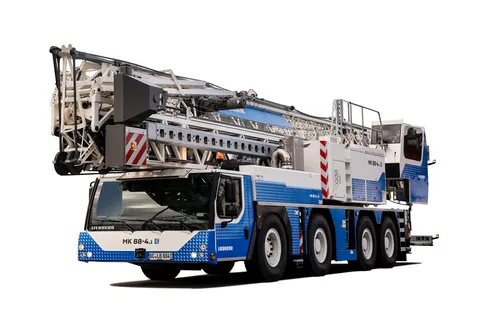
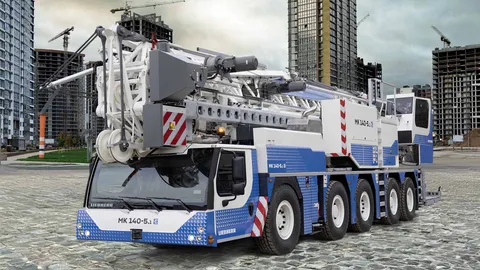
- Mobile tower cranes: a tower and horizontal jib on a road-going chassis, for work right against buildings – Liebherr MK 88-4.2E, Spierings SK487-AT3. See our mobile tower crane overview.
- Loader cranes: a knuckle boom on a truck that also carries the load.
At a glance
| Type | Drives to site | Lifts without outriggers | Travels with load | Set-up | Typical stay |
|---|---|---|---|---|---|
| Truck crane | yes | no | no | minutes | hours to days |
| All Terrain | yes, often on permit | no | limited | minutes to hours | hours to weeks |
| Rough terrain | no | yes | yes | minutes | weeks to months |
| Lattice crawler | no | yes | yes | days | months |
| Telescopic crawler | no | yes | yes | hours | weeks to months |
| Mobile tower | yes | no | no | minutes | hours to days |
Using the table
A crane that changes address daily is a truck crane or an All Terrain, with budget, reach and access deciding between them. A crane that stays and must move around the site is a rough terrain or telescopic crawler. Once loads reach hundreds of tonnes or heights pass a hundred metres, the lattice crawler has little competition. Carrier chosen, the next step is tonnage class and the load chart.