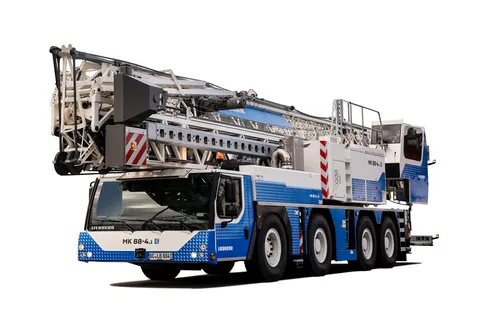
Mobile tower cranes occupy a small corner of the crane market, and only two manufacturers build them in series: Liebherr in Germany with the MK range and Spierings in the Netherlands with the SK range. In one week of November both made news – Liebherr with the MK 88-4.2E and Spierings with the first all-electric City Boy for Germany. This overview sets the two ranges side by side.
Why choose one over a telescopic crane
A telescopic crane of similar weight lifts more. Its boom, however, approaches the load at an angle and loses radius over the edge of a building. A mobile tower crane has a vertical tower and a horizontal jib, so it can stand against the façade and reach across the whole roof. One operator drives it to site and erects it in minutes. The typical work is roofing, plant installation and façade jobs in built-up areas, often several sites in a day – the "taxi crane" model.
The ranges
Capacities are modest and close together: 6 to 10 tonnes on the wheeled models. The real differences are radius, height and axle count.
Liebherr MK
| Model | Axles | Max. capacity | Jib tip capacity | Max. hook height |
|---|---|---|---|---|
| MK 73-3.1E | 3 | 6 t | 2.0 t | 51.0 m |
| MK 88-4.2E | 4 | 8 t | 2.2 t at 45 m | 59.1 m |
| MK 120-5.1E | 5 | 8 t | 2.1 t | 70.6 m |
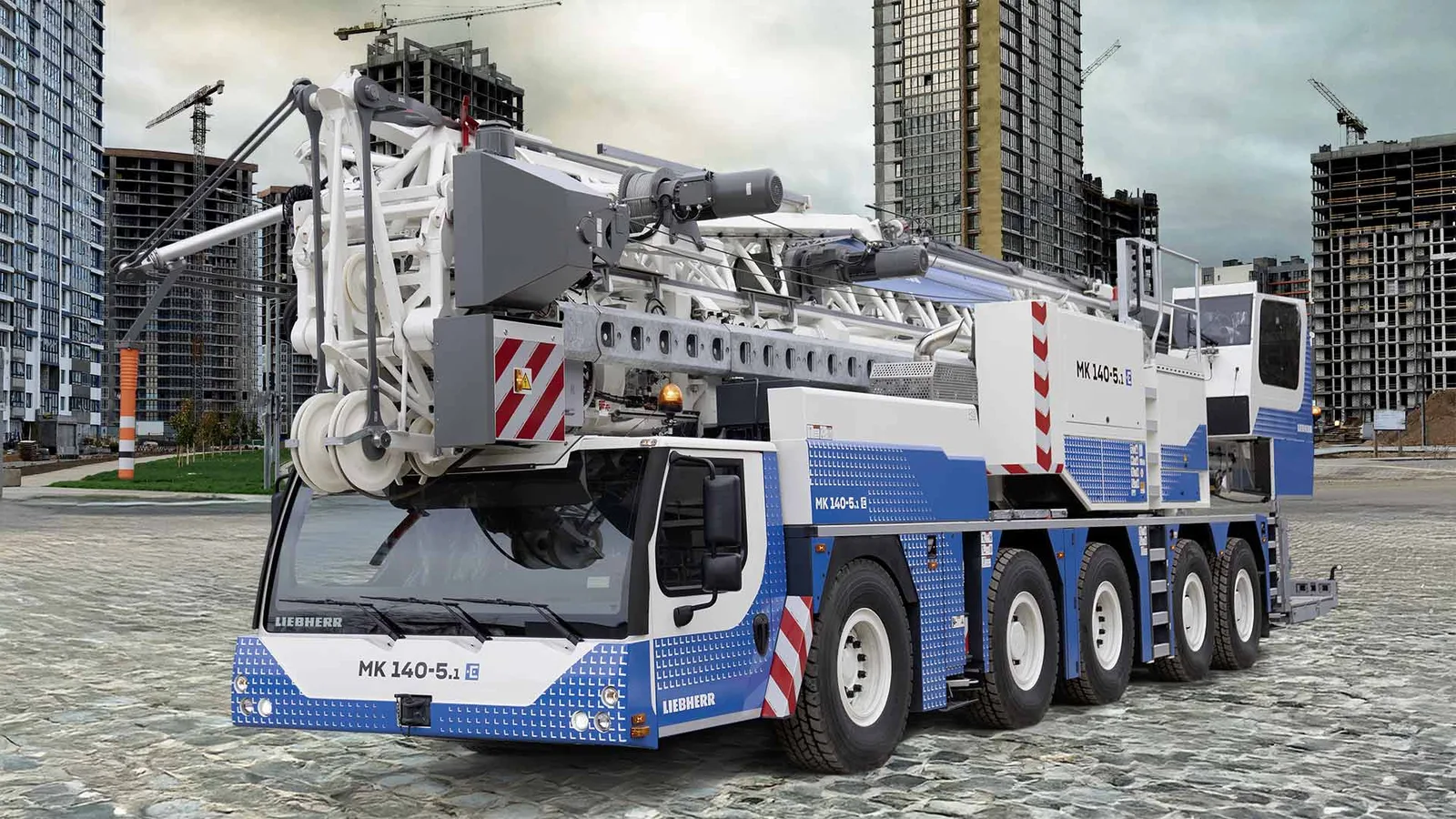
| MK 140-5.1E | 5 | 8 t | 1.9 t at 65 m | 94.4 m |
Spierings SK
| Model | Axles | Max. capacity | Jib tip capacity | Max. hook height | Set-up |
|---|---|---|---|---|---|
| SK487-AT3 eDrive | 3 | 7 t to 11.96 m | 1.7 t at 40 m | 55.45 m | 15 min |
| SK597-AT4 eLift | 4 | 7 t to 14.1 m | 1.7 t at 48 m | 58.1 m | 8 min |
| SK1265-AT5 eLift | 5 | 10 t to 13.2 m | 1.7 t at 60 m | 64.2 m | 11 min |
| SK1265-AT6 eLift | 6 | 10 t to 13.2 m | 1.7 t at 60 m | 64.2 m | 11 min |
Hook heights are with the jib luffed, in most cases to 30 or 45 degrees. Spierings also builds the crawler-mounted SK2400-R, rated at 18 tonnes with 5.5 tonnes at 42 metres, which takes about an hour to rig and belongs on longer jobs.
Reading the tables
Headline tonnage tells little
Tip load moment is more useful: 2.2 t × 45 m gives roughly 99 tonne-metres for the MK 88-4.2E, against about 82 for the four-axle SK597-AT4 at 1.7 t × 48 m. Liebherr carries more; Spierings reaches three metres further.
Spierings scales by jib length
Every wheeled model holds the same 1.7 tonnes at the tip while radius grows from 40 to 60 metres. Liebherr reaches 65 metres only at the top of its range.
Liebherr scales by height
The MK 140-5.1E has the VarioJib, which converts from trolley jib to luffing jib in minutes; in luffing mode the manufacturer quotes a 94.4 metre hook height, some 30 metres above the largest Spierings.
Axles are a road question, not a lifting one
The SK1265 is offered on five or six axles with an identical chart, the sixth axle spreading the weight. Liebherr's answer on the MK 88-4.2E is a removable counterweight that brings axle loads under 9.2 tonnes.
Drives
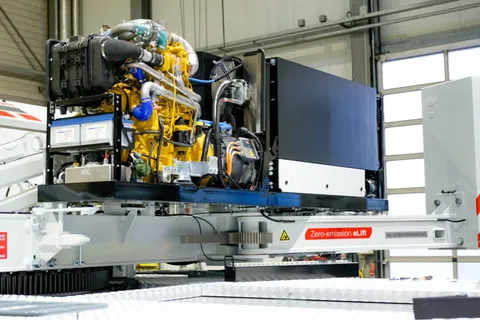
Both ranges lift electrically. MK cranes take site power or run their own generator, and Liebherr says the MK 88-4.2E works from a 16 amp supply. Spierings has fitted its eLift battery system since 2020, allowing emission-free lifting without a grid connection.
Only the three-axle SK487-AT3 also travels on electric power, with a small diesel as a range extender. Everything else in both ranges still drives to site on diesel.
Which crane for which job
- Tight urban sites: MK 73-3.1E or SK487-AT3, the latter where low-emission zones apply.
- General rental fleets: MK 88 or SK597-AT4, trading load against reach.
- Tall buildings: MK 140-5.1E in luffing mode.
- Long reach across wide roofs: SK1265 with its 60 metre jib.
- Markets with strict axle limits: MK 88-4.2E or the six-axle SK1265-AT6.
Neither manufacturer publishes prices, and Spierings' public data does not state battery running time or electric driving range – the first questions for any buyer.