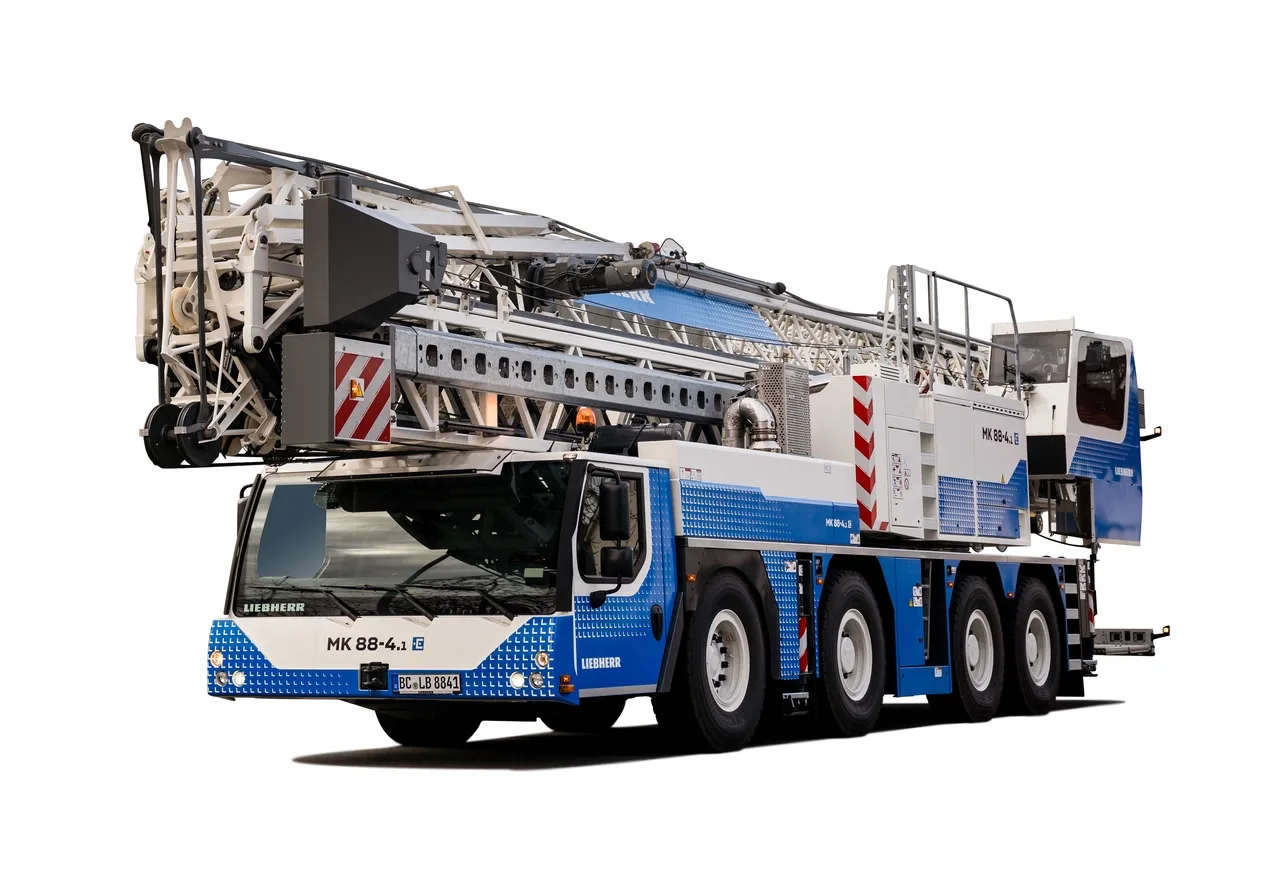
Liebherr's new MK 88-4.2E lifts exactly what its predecessor did. What changed is the carrier: the crane can now travel at under 9.2 tonnes per axle instead of the usual 12. The company redesigned chassis, counterweight and outriggers for the sake of three tonnes an axle. Road rules explain why.
Where the limit comes from
Roads and bridges are damaged not by total vehicle weight but by what each axle transmits and how closely the axles are spaced. Regulations therefore cap axle loads and, for heavy vehicles, axle group loads. The further a crane exceeds them, the harder the permit: fixed routes, escorts, barred roads and bridges.
The limits
There is no single standard. Trade press and manufacturers describe the following picture:
| Market | What applies to cranes |
|---|---|
| Mainland Europe | 12 tonnes per axle predominates; travel without permits or on routine ones |
| Europe, "truck" mode | 10 tonnes per axle and 32 tonnes gross for two and three axle cranes – unrestricted in most countries |
| United Kingdom | STGO rules with categories up to 12.5 and up to 16.5 tonnes per axle |
| Norway | 10 tonnes on some roads and as low as 8 on others, rental companies report |
| Singapore, Hong Kong | up to 15 tonnes with documentation from crane and tyre makers |
| USA | varies by state and depends on axle spacing; large cranes often travel with a boom dolly |
These figures come from industry sources of different dates and are a guide, not a statement of current law. Check national rules before moving a crane.
Why cranes are built around 12 tonnes
The European limit sets the arithmetic for a whole class: axles multiplied by 12 tonnes is what a crane may weigh on the road – 60 tonnes on five axles, 96 on eight. Whatever does not fit travels separately. So the key question for any All Terrain is what it carries at 12 tonnes per axle.
- The five-axle, 150 tonne Liebherr LTM 1150-5.4E weighs 60 tonnes with 9 of its 45 tonnes of counterweight on board, ready for light lifts on arrival.
- The eight-axle, 450 tonne LTM 1450-8.1 keeps its 85 metre boom, outriggers and winch within 12 tonnes; all counterweight follows.
- The six-axle, 300 tonne Grove GMK6300L-1 can travel with up to 21 tonnes of counterweight where rules allow, Manitowoc says.
- The four-axle, 70 tonne Tadano AC 4.070L-1 carries 12.2 tonnes of counterweight at 12 tonnes per axle and 16.5 tonnes under the higher UK limit.
More counterweight on board means fewer support trucks – real money for a taxi crane doing several short jobs a day.
Five ways to meet the limit
- Remove what can be removed: counterweight, hook blocks, jibs and, on the largest machines, outriggers or the boom. The MK 88-4.2E has a sectional counterweight and removable outrigger beams, and re-ballasts itself in two or three lifts.
- Add an axle. Spierings offers the SK1265 on five or six axles with the same chart. Terex-Demag once offered a modular sixth axle for five-axle cranes, requested by Dutch customers who wanted to carry all their counterweight.
- Use a dolly or trailer for the boom or the ballast, common in North America.
- Change tyres. Wider tyres spread the load. The MK 88-4.2E runs on 445/75 R22.5, which Liebherr links to access to Australia, Denmark and the USA.
- Offer several travel modes from the factory – 12, 10 and under 9.2 tonnes on the MK 88-4.2E.
The cost of a light axle
Every tonne removed costs time and transport. At 9.2 tonnes the crane arrives without counterweight, needing a second vehicle and time to ballast, and part of the mobile tower crane's drive-in, lift-in-fifteen-minutes advantage is lost. How much is rarely published: Liebherr has not stated the weight of the removable components or the set-up time in the lightest mode.
What to look for in a specification
- Axle load and gross weight for each travel configuration, not a single figure.
- Counterweight carried in each mode.
- Self-ballasting, and whether an assist crane is needed.
- Axle spacing, which decides how the crane fares under local bridge formulas.
Manufacturers themselves expect heavy transport rules to keep tightening. Expect more road versions of the same model, with the light axle moving from a country-specific option to a standard line in the data sheet.