A few years ago an electric mobile crane was a show exhibit. In 2026 such machines are being delivered in several classes, from city cranes to crawlers of several hundred tonnes. "Electric", though, covers three different concepts, and the real choice is among them.
Three concepts
Grid-powered
The crane runs from site electricity with no battery; diesel remains for travel and as back-up. Liebherr's MK mobile construction cranes and its LTC 1050-3.1E compact crane, first shown in 2022, work this way. It is simple, but needs an adequate supply.
Battery-buffered
A battery pack is added. The crane can work with no connection at all, and on a weak supply the battery covers peak demand while charging. Diesel still handles the road.
Fully battery-electric
Electric power for both lifting and travel, with any combustion engine reduced to a range extender.
What is on the market
All Terrain
The 150 tonne, five-axle Liebherr LTM 1150-5.4E pairs a 111 kW electric motor with a 99 kWh battery weighing 1.5 tonnes at the rear. Liebherr quotes up to four hours of untethered operation, charging from 16, 32 or 64 amp sockets at up to 44 kW or fast charging at up to 80 kW. The 400 kW diesel remains for travel. Mammoet received the first unit in December 2025, with series deliveries planned from spring 2026. Grove offers plug-in hybrids with a 180 kWh pack and a 170 kW generator in the carrier, quoting around five hours of lifting. Tadano supplies its external e-Pack for some All Terrains.
Rough terrain
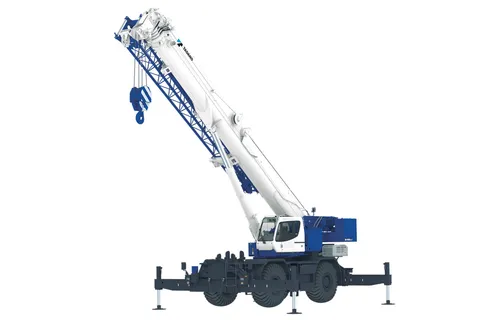
Tadano's EVOLT eGR-1000XLL-1 matches the chart of its 100 US ton (about 90 tonne) diesel sibling, with a claimed seven hours of lifting, or five hours plus roughly 9 kilometres of site travel.
Mobile tower
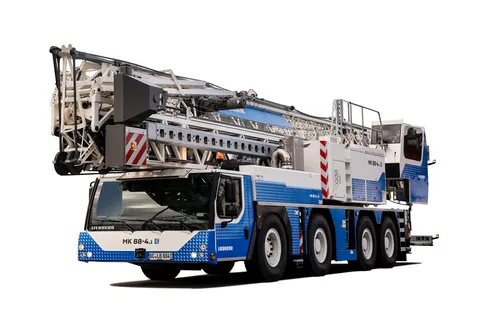
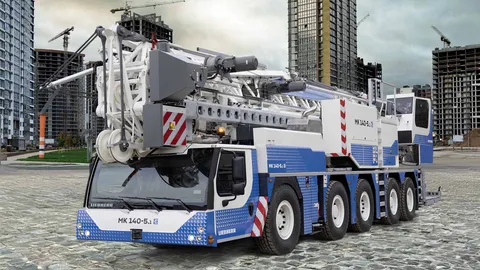
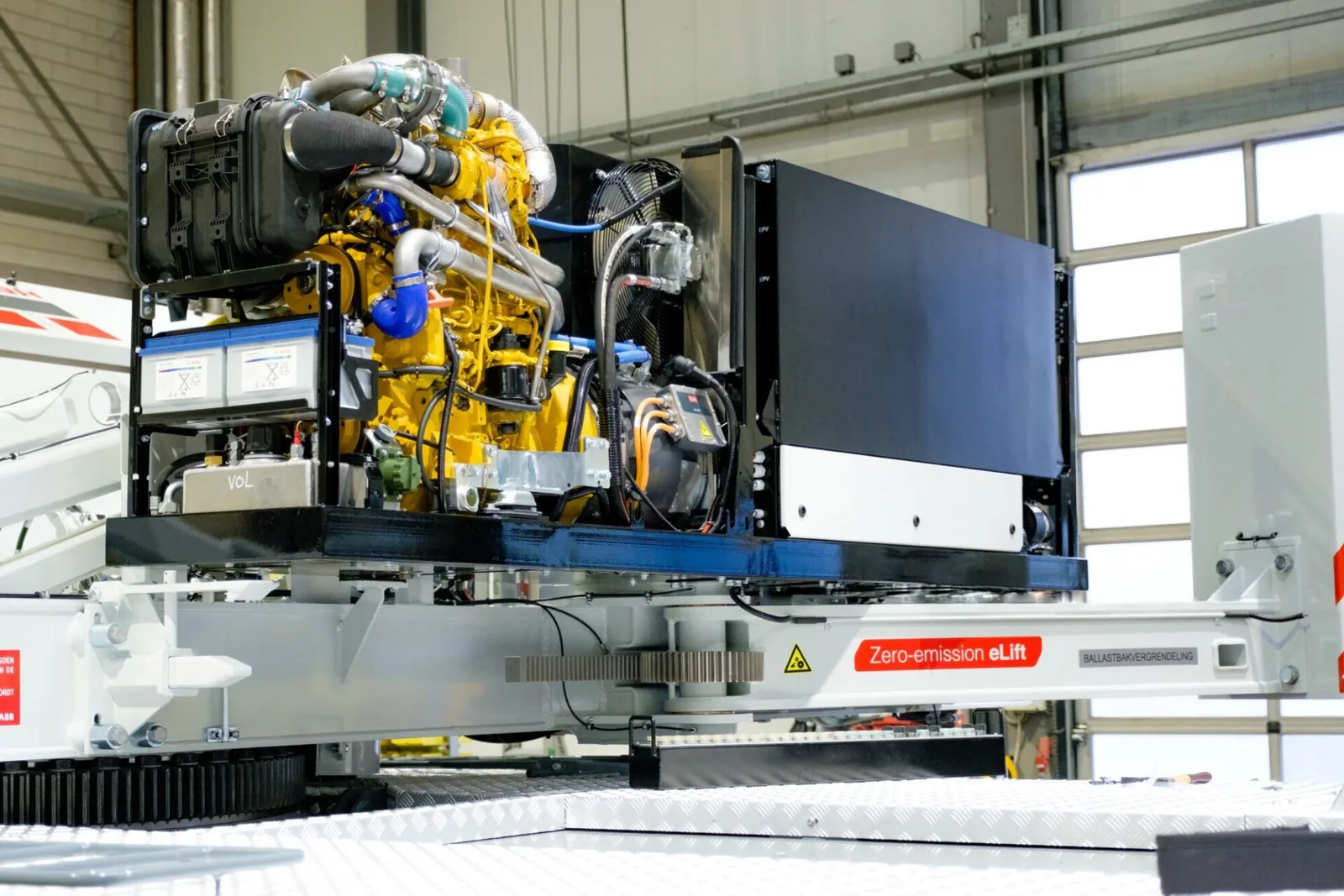
Spierings has fitted its eLift battery system since 2020. The three-axle SK487-AT3 eDrive also travels electrically, and one has just gone to a German fleet for the first time. Liebherr's MK cranes run from the mains; the new MK 88-4.2E needs only a 16 amp supply, the company says.
Crawler
Liebherr showed a battery-powered unplugged version of the 300 tonne LR 1300 at Bauma 2025. Sany's all-electric 200 tonne SCC2000A-EV is in service with Sarens, and Zoomlion showed the 150 tonne ZCC1500V-1EV at bauma China 2024.
Harbour
The Konecranes Gottwald ESP.6 is available with a capacitor-based hybrid drive, as ordered this month for Matarani in Peru.
What it adds up to
Electric power is, for now, a site feature rather than a road one
Nearly every wheeled crane listed still drives to work on diesel; the 36 tonne Spierings is the exception. On a 60 tonne carrier a traction-sized battery would eat into the counterweight the crane can carry within its axle loads – the LTM 1150-5.4E's 1.5 tonne pack serves crane functions only.
Crawlers have it easier
They face no road limits, battery mass doubles as ballast, and long stays in one place simplify charging. That is where electric machines have reached 200 to 300 tonnes.
The buffer battery also solves a quieter problem: full crane performance from a 16 or 32 amp socket, which is often all a site can offer.
On running time, the only public operator estimate comes from Mammoet, which analysed two weeks of fleet data in the Netherlands and expects to work on battery alone nine days out of ten. That is one operator's projection for its own duty cycle, not a test result.
What manufacturers do not say
- Price, and the premium over diesel.
- Battery life in cycles and replacement cost.
- Running time under heavy duty; the four to seven hour claims come without a defined load cycle.
- Cold-weather performance.
- Driving range where the carrier is electric.
Who needs one now
Fleets working in zero-emission zones and under night-time noise limits, chiefly in the Netherlands and Scandinavia; those lifting indoors; and contractors whose clients write site emissions into the contract. For everyone else the economics remain unproven – but an electric option now exists in every main crane class, which was not true three years ago.