Overhead and gantry cranes rarely make the news, yet they handle more loads than any other crane type – in every workshop, steel stockyard and precast plant. They are not bought on tonnage alone. Two 10 tonne overhead cranes with the same span can differ widely in price and service life, because one is designed for a few lifts a day and the other for three-shift operation. Here is what drives the choice.
This guide is for reference only and does not replace standards or the manufacturer's design calculations.
Overhead versus gantry
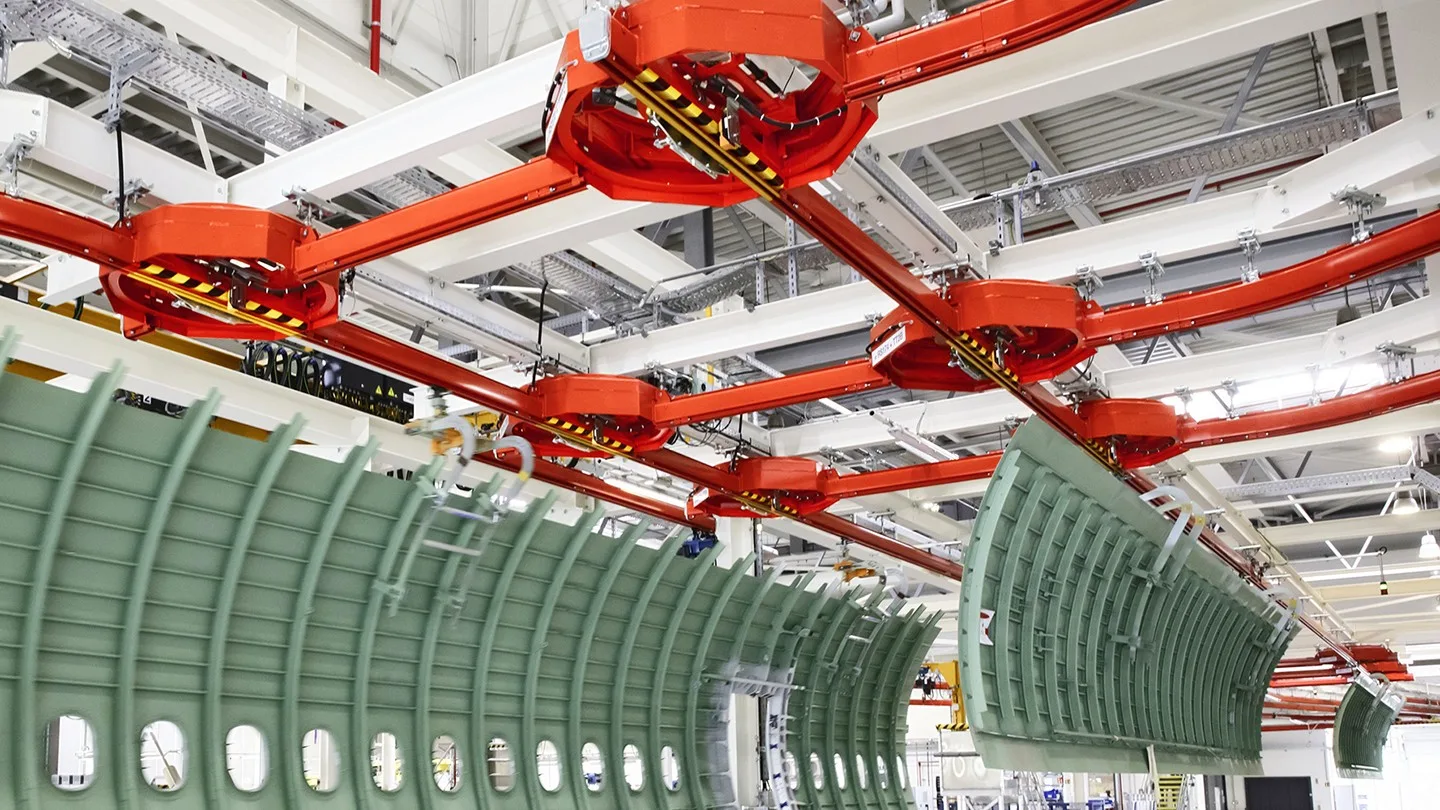
An overhead crane (bridge crane) is a bridge of one or two girders travelling on runway rails carried by the building's columns or a gantry structure. A trolley or hoist with the hook runs across the span. The crane works inside the building and uses its structure for support.
A gantry crane is the same bridge on its own legs, travelling on rails at ground level. No elevated runway is needed, so gantry cranes work outdoors – steel and timber yards, precast plants, container yards (see our guide to port cranes) and shipyards. When one end of the bridge runs on a building wall and the other on a leg, it is a semi-gantry.
Underhung or suspension cranes, hanging from runways fixed to the roof structure, are a lighter variant with modest capacities.
Single or double girder
This is the first decision for an overhead crane.
| Single girder | Double girder | |
|---|---|---|
| Typical capacity | up to 10–20 t | from 5 t to several hundred tonnes |
| Typical span | up to 20–30 m | no fundamental limit |
| Hoist position | slung under the girder | running on top of both girders |
| Hook height | lower | higher in the same building |
| Weight and cost | lower | higher |
Demag's standard crane kits, for example, run to 10 tonnes and 30 metre spans in single girder form and to 50 tonnes as double girder cranes. US distributor Mazzella puts typical single girder cranes at up to 20 tonnes and spans of around 20 metres, and double girder cranes at 20 to 400 tonnes.
On a double girder crane the trolley sits on or between the girders, so the hook rises almost to bridge level and gives more useful lift in the same building. The space between the girders can also carry a maintenance walkway – important on heavily used cranes.
Duty class: the key figure after tonnage
A crane that lifts its rated load once a week and one that handles near-capacity loads all day are built differently. Duty classification captures this.
The crane as a whole is placed in one of eight groups, A1 to A8, under ISO 4301-1 and the FEM 1.001 rules. The group combines: - the class of utilisation (U0–U9) – how many working cycles the crane will perform over its life; - the load spectrum class (Q1–Q4) – how often it lifts loads close to its rating.
Mechanisms, above all the hoist, are classified separately – M1 to M8 under ISO 4301-1, or 1Dm to 5m under FEM 9.511. The equivalents are: 1Bm = M3, 1Am = M4, 2m = M5, 3m = M6, 4m = M7, 5m = M8. A mechanism's group depends on its average daily operating time and its load spectrum, L1 to L4 (light to very heavy).
The newer European standard, EN 13001, uses the same basic classes but does not combine them into a single crane group; manufacturer and user are expected to agree the actual number of cycles and load masses. In the US, the six CMAA service classes, A to F, are used. In CIS countries, cranes have traditionally been classified under GOST 25546 (Gosudarstvenny standart, State Standard) duty groups 1K to 8K.
Estimating a mechanism group
An example from a hoist manufacturer's method: a 3 tonne hoist lifting at 8 m/min, average lift height 3 metres, 16 cycles an hour, eight hours a day, mostly heavy loads.
Average daily operating time comes to around 3.2 hours (counting raising, lowering and empty moves). With a heavy load spectrum that points to group 3m (M6). With light loads, a lower-group – lighter and cheaper – mechanism would do.
Typical groups by application, from manufacturers' tables: - warehouse cranes – 2m–3m (M5–M6); - magnet cranes in steel stockyards – 3m–4m (M6–M7); - automated and special-purpose cranes – 4m–5m (M7–M8).
Under-specifying by one or two groups is a common cause of premature wear on ropes, bearings and brakes. Over-specifying costs money.
Other factors
- Span and runway. For an overhead crane the building sets the span, and the runway must carry the wheel loads. For a gantry crane, the rails and foundations on site.
- Lift height and clearance over plant in the building.
- Speeds and smoothness. Frequency-controlled drives on travel and hoist reduce load sway.
- Control. Pendant, radio remote or cab – cabs are mostly found on heavy, intensively used cranes in large halls.
- Environment. Explosive atmospheres, foundries and low outdoor temperatures call for special designs.
- Load handling. Hook, magnet, grab, spreader beam or tongs all change both the weight and the duty.
In short
Overhead cranes are for buildings, gantry cranes for open yards. Single girder suits light loads and moderate spans; double girder suits heavy loads, long spans and intensive use. After tonnage, the decisive parameter is duty: the crane group A1–A8 and the hoist mechanism group M1–M8 (1Bm–5m), set by the real number of cycles and load masses rather than by maximum capacity.