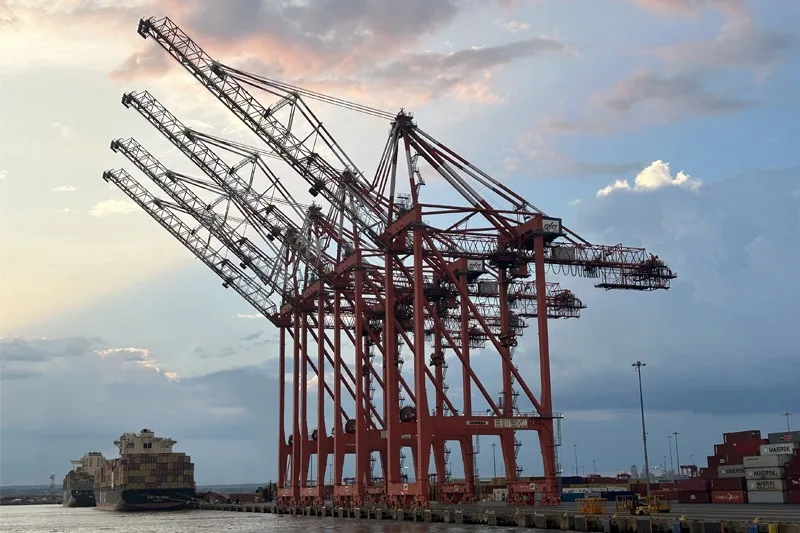
A ship-to-shore crane at berth 12 of Yantian port in Shenzhen, southern China, was brought down around midday on 9 November when the container ship Maersk Cincinnati hit it while coming alongside. The crane fell away from the water, landing partly next to the ship and partly on boxes stacked in the yard. There have been no reports of anyone hurt. The emergency management bureau of Yantian District is looking into the incident.
What is known
- The ship: Maersk Cincinnati, 15,516 TEU, 366 metres long and 51 metres wide, Singapore-flagged, deployed on an Asia–North Europe service. It stayed at the quay longer than planned after the incident.
- Weather: that morning, Shenzhen's weather office warned of monsoon winds with gusts of force 8 or more. Chinese shipping sources link the accident to a sudden gust while the ship was manoeuvring; no official cause has been given.
- Damage: how badly the crane is damaged, and what this means for the terminal, is not known. Maersk and the terminal operator have not commented in detail.
Yantian has had a crane accident before. On 16 September 2024, at berth 2, the boom of an STS crane came down on the feeder MSC Riona, a ship of around 1,730 TEU. Some containers went into the sea but nobody was hurt, and the port took two sister cranes out of service until they had been checked.
Why STS cranes are vulnerable during berthing
A ship-to-shore crane is a rail-mounted gantry with a long boom that reaches out over the vessel during loading (see our guide to port cranes). When a ship comes alongside, the boom is raised almost vertical to clear the superstructure and hull, but the crane's legs and raised boom still stand right at the quay edge.
A large container ship caught by a gust is hard to hold on line, even with tugs. A sideways drift of a few metres can bring the hull, the superstructure or the bow flare into contact with a crane. STS cranes are tall and heavy, but they are designed for loads from above and along the quay, not for a lateral impact from a ship's hull. That is why ports restrict berthing of large vessels in high winds and move cranes away from the approach.
We will update this report when the investigation's findings are published.
Source: WorldCargo News