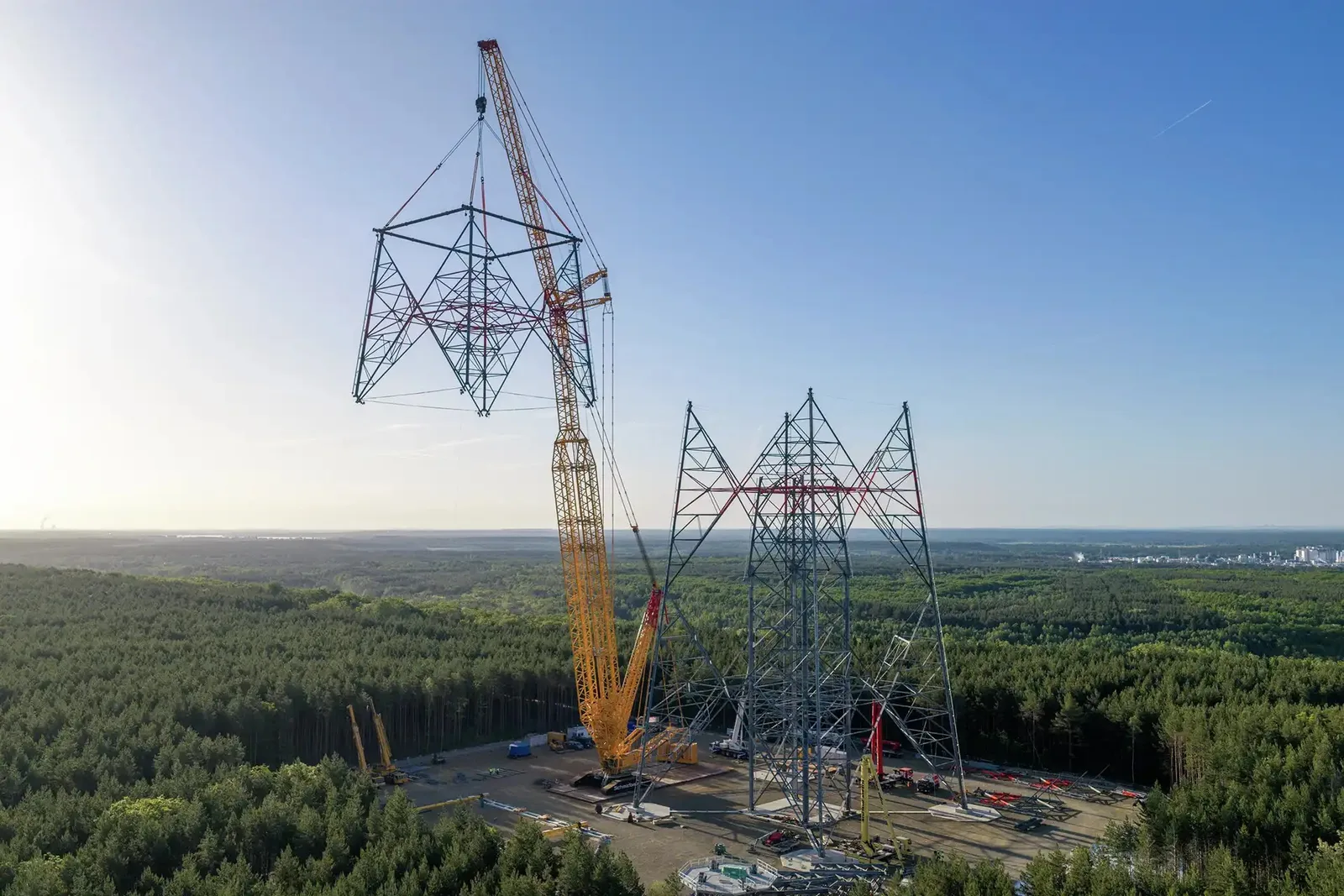
The tallest wind turbine on Earth now stands at Schipkau in Lusatia, in the German state of Brandenburg. On 28 September the prototype developed by Dresden engineering firm GICON reached its full height of 365 metres, with its hub at 300 metres. In Germany only the Berlin TV tower, at 368 metres, is taller. Most of the lifting was done by Schmidbauer's Liebherr LR 11350 crawler crane, and Liebherr described the job on 19 October.
A tower that extends itself
Most turbine towers are steel or concrete tubes. GICON's is a steel lattice structure in two parts. The inner tower is assembled inside the outer one and later pushed upwards, telescope-fashion.
That solves the crane problem. No crawler crane can place a nacelle and blades 300 metres up, so the blades went on while the tower was still around 160 metres tall. A built-in system then raised the inner tower, with the turbine on top, to its final height.
The turbine is a 3.8 MW Vensys unit with a 126 metre rotor. Germany's federal agency for breakthrough innovation, SPRIND, is funding the project, and GICON intends to commission the turbine in November.
Two crane configurations
The LR 11350 arrived in spring 2025 and stayed for about a year and a half, rigged differently for each phase (our guide to heavy crawler cranes explains derricks and counterweight).
| Phase | Configuration | Work |
|---|---|---|
| Tower up to about 160 m | PowerBoom parallel boom, jib tip up to 84 m; up to 850 t of ballast on the crane and the derrick ballast tray | lattice tower modules |
| Blade installation | 114 m main boom with 84 m luffing jib, head at 200 m | three blades at about 170 m |
Changing over from one set-up to the other took six days.
The heaviest lift was a tower module measuring roughly 40 by 40 by 40 metres and weighing 375 tonnes gross. The crane set it on a 50 metre base structure at a radius of about 44 metres, travelling on a purpose-built roadway of steel plates and bongossi hardwood.
The blades had to wait several days for calm weather. Once it came, all three were fitted within 12 hours, partly at night. Smaller Liebherr mobile cranes handled ballasting, the base structure and pre-assembly of tower sections.
Two records, two cranes
September brought Germany two record turbines, and they are easy to confuse. The other is a series-built Vestas on a Max Bögl tower.
| GICON, Schipkau | Max Bögl / Vestas, Winnberg | |
|---|---|---|
| Total height | 365 m | 285 m |
| Hub height | 300 m | 199 m |
| Type | one-off prototype | series-built turbine |
| Crane | Liebherr LR 11350 | Tadano CC 78.1250-1 |
GICON's is the tallest turbine of any kind; Max Bögl's is the tallest series-built one. Their hubs are about 100 metres apart in height. GICON argues that stronger, steadier wind at 300 metres will justify the more complex tower; the prototype now has to prove it.
Source: Liebherr