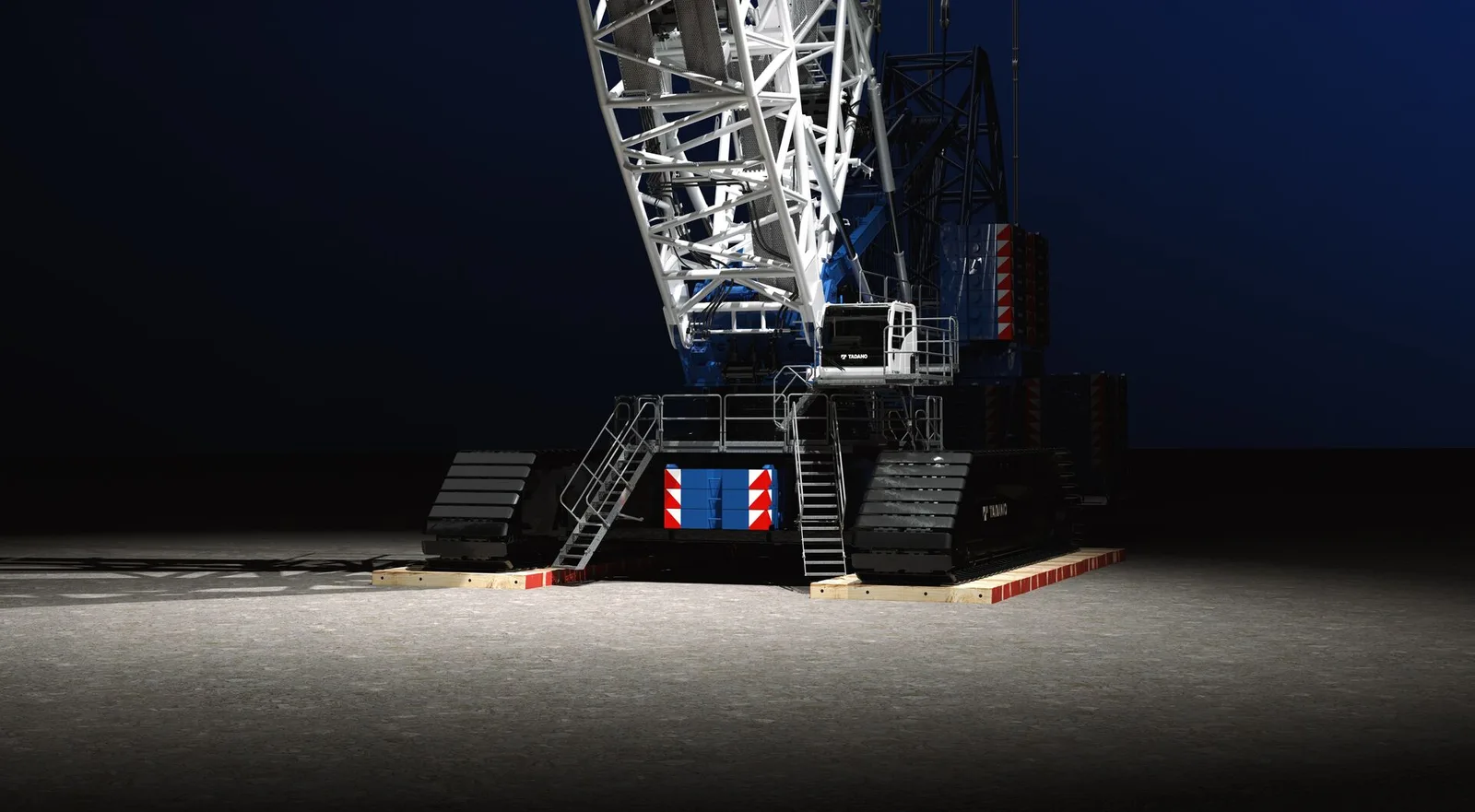
A Bavarian building group has a new landmark next to its headquarters. At Winnberg, near Sengenthal, a 7.2 MW Vestas turbine now stands on a Max Bögl hybrid tower, with its hub at 199 metres and a blade tip reaching 285 metres. Max Bögl says no series-built onshore turbine anywhere is taller. The lifting was done by crane contractor Steil with a Tadano CC 78.1250-1 lattice boom crawler.
The crane configuration
| Specification | Value |
|---|---|
| Crane | Tadano CC 78.1250-1 lattice boom crawler |
| Main boom | 203.5 m, with Boom Booster |
| Fixed jib | 15 m |
| Footprint | 12 x 13 m |
Boom Booster is an add-on that stiffens the main boom; without it, a boom this long could not carry a nacelle and rotor. Its parts fold up for the road and are bolted together on arrival, so they travel on normal trucks. Steil believes no CC 78.1250-1 had been rigged like this before; Max Bögl describes it as a first for Europe. Tadano sent service technicians to support the job. Our guide to heavy crawler cranes explains how such cranes and their stiffened booms work.
Why so tall
Almost 108 metres of the tower is made of concrete rings; the rest is steel. Wind blows harder and more evenly the higher you go, which is why inland projects favour tall towers. The new turbine should produce 17–18 million kWh a year – with the company's other installations, enough for about two-thirds of the electricity used at its Sengenthal base.
For comparison, the turbines Max Bögl built at Gaildorf in 2017 – then the world's tallest – had a 178 metre hub height and a total height of 246.5 metres.
The turbine should start operating within weeks. Lift dates have not been published.
Source: Max Boegl