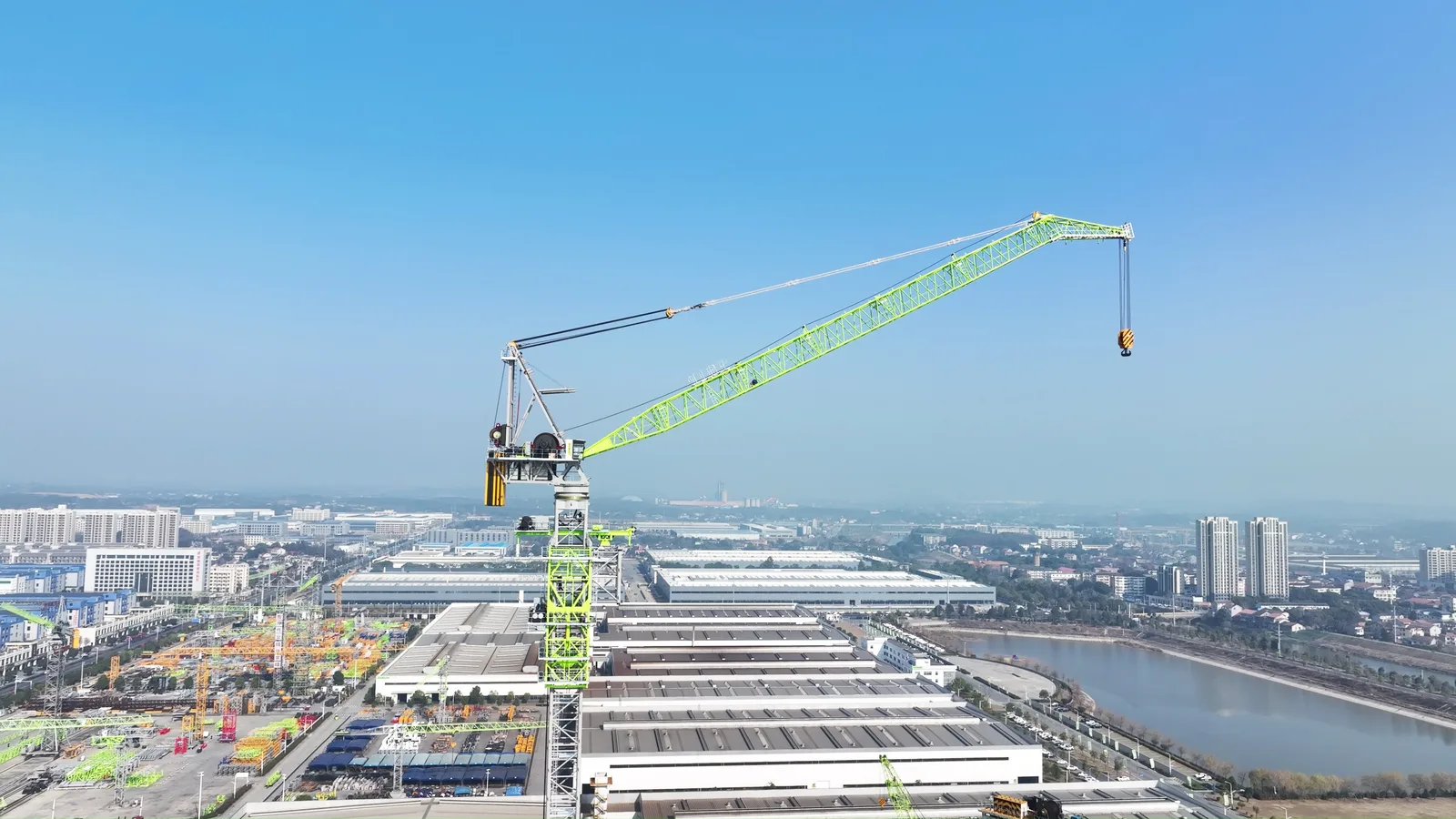
Zoomlion's LW3600-240NB, billed by its maker as the tallest and most powerful crane built for wind turbine installation, has gone to work. In early November Zoomlion said the crane had arrived on a mountain wind farm in Shanxi province, in the Taihang range. The project's name and the type and height of the turbines have not been disclosed.
The crane was launched on 3 February 2026 at Zoomlion's tower crane plant in Changde, Hunan province, where it made its first lift – a 300 tonne test weight.
The crane
| Specification | Value |
|---|---|
| Maximum load | 240 t |
| Lifting height | over 241 m with an extra tower support, over 223 m without |
| Jib length | 70 m |
| Base frame | 20 x 20 m between support centres |
| Site needed | 35 x 55 m |
| Ground bearing pressure | up to 0.18 MPa |
Zoomlion pitches it at turbines of 10 MW and more, with hubs at 200 metres or higher. It says the crane can stand winds of up to force 10 when out of service and climbs on two synchronised hydraulic cylinders. The first buyer, announced at the launch, was Fengling, a Chinese builder of hybrid concrete-and-steel turbine towers.
Why a tower crane rather than a crawler
Nacelles and blades are normally lifted by lattice boom crawlers (see our guide to heavy crawler cranes). The taller the hub, the longer the boom and the more counterweight a crawler needs – and the larger and firmer the crane pad has to be. In mountains that pad must be cut out of the slope.
A wind turbine tower crane works differently. It stands on its own base frame next to the turbine tower and grows with it, section by section. It needs less space, puts less load on the ground, and its 70 metre jib stays the same whatever the hook height. That is why Chinese builders see it as the answer for hilly and cramped sites.
There are drawbacks. The crane has to be rebuilt at every turbine and works from one spot, whereas a crawler can sometimes walk to the next position with its boom partly rigged. Zoomlion has not said how long the LW3600-240NB takes to move between turbines; for the earlier LW2800A-200NA it quoted 2.5 days to dismantle, transport and re-erect.
Not only in China
Turbines are getting taller in Europe too. In September Germany saw two record turbines: a series-built Vestas on a Max Bögl tower with a 199 metre hub, erected with a Tadano CC 78.1250-1, and GICON's 365 metre prototype with a telescopic tower, built with a Liebherr LR 11350. Both jobs were done with crawler cranes.
Source: Zoomlion