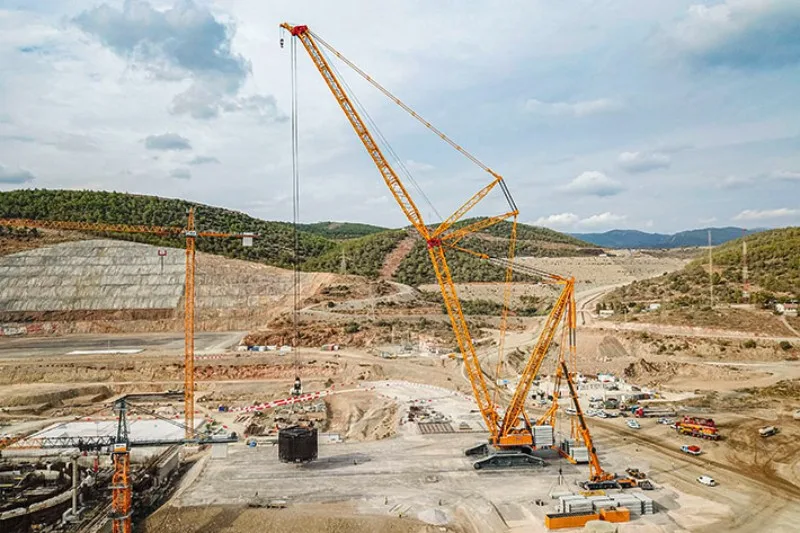
The strongest series-built crawler crane, the Liebherr LR 13000, lifts up to 3,000 tonnes (see our guide to heavy crawler cranes). Yet nuclear power stations, petrochemical plants and shipyards produce heavier loads still: reactors, columns, whole process modules and offshore wind foundations. For these there is a class of its own – the ring crane. Only a handful exist, and most of them have names.
How a ring crane works
The principle is the same as a crawler with a derrick: boom in front, counterweight behind, both slewing around a common axis. The difference is the base. Instead of tracks, the crane stands on a large ring of steel beams laid on prepared ground, tens of metres in diameter. The boom foot and the counterweight run around it on multi-wheel bogies.
What that gives:
- Supports far from the slewing centre. Stability depends on how far the boom foot and counterweight sit from the centre. On a ring 40 to 50 metres across, both lever arms are far longer than on any crawler.
- Load spread around the whole ring. Ground pressure is lower than under the tracks of a crawler with similar capacity.
- Enormous counterweight, measured in thousands of tonnes.
The price is just as obvious: the crane does not travel. It is built in one place and works from there for months or years, with loads brought to it rather than the other way round. Ring cranes therefore pay off where many super-heavy lifts are concentrated on one site.
The figure that matters: load moment
For giant cranes the headline capacity says even less than usual (see "Why a 150 tonne crane rarely lifts 150 tonnes"). It applies only at a fairly short radius, and permitted loads drop quickly further out. These cranes are therefore compared by maximum load moment – the load multiplied by its radius.
| Liebherr LR 13000 | Sarens SGC-250 | Mammoet SK6000 | XCMG and Sinopec, 14,000 t | |
|---|---|---|---|---|
| Type | crawler | ring | ring | ring, two units |
| Maximum capacity | 3,000 t | 5,000 t | 6,000 t | 14,000 t (2 x 7,000 t) |
| Maximum load moment | 65,000 tm | 250,000 tm | – | 700,000 tm |
| Height | – | up to 250 m | up to 273 m | – |
Figures from manufacturers and owners; a dash means not published.
The gap to crawlers is bigger than the tonnage suggests. In load moment the Sarens ring crane is almost four times as powerful as the LR 13000, and the new Chinese crane more than ten times.
The giants
Sarens SGC-250 "Big Carl"
Belgium's Sarens designed and built this crane itself and unveiled it in 2018. The main boom runs to 160 metres and the jib to 100 metres, for a height of around 250 metres and a maximum radius of 275 metres. It lifts 5,000 tonnes at 40 metres radius and 2,000 tonnes at 100 metres. The ring is 48.5 metres across and rests on 128 wheel bogies. Since 2019 the crane has been at the Hinkley Point C nuclear power station in England, where its contract covers more than 600 prefabricated components, including the steel domes of the reactor buildings. Earlier members of the family are the SGC-120 and SGC-140.
Mammoet SK6000
The Dutch company assembled it in 2024 and calls it the strongest crane on land. It is rated at 6,000 tonnes with 4,200 tonnes of ballast. The mast reaches 171.5 metres, and with a fixed jib the total height is 273 metres; it can raise 3,000 tonne components to 220 metres, and its maximum radius is 144 metres. Testing was overseen by Lloyd's Register. The SK6000 can run entirely on electricity, from the grid or from batteries – two 600 kWh packs were used in its tests – and travels in 300 shipping containers. Its main target is offshore wind: foundations, extra-large monopiles and floating bases.
XCMG and Sinopec, 14,000 tonnes
On 28 August 2026 in Xuzhou, Chinese manufacturer XCMG rolled out the first of two units of a ring crane developed with the heavy-lifting arm of oil and chemicals group Sinopec. Each unit is rated at 7,000 tonnes and can work alone; together they are meant to lift 14,000 tonnes with a load moment of 700,000 tonne-metres. XCMG says the drive is electric and direct, without intermediate hydraulics, saving more than 30 per cent of the energy. The crane is aimed at nuclear, petrochemical and offshore wind work; according to XCMG, from one position it will be able to handle modules for two reactor buildings. The second unit is still being built.
Why cranes keep growing
The reason is a change in how things are built. A process plant or reactor building used to be assembled on site from thousands of small parts. Now they are increasingly made in factories as large modules, shipped in and set in one piece. Each module is heavier, but construction is faster and fewer people are needed on site – and the bigger the modules, the stronger the crane must be. The same is happening in offshore wind, where foundations and towers get heavier with each generation.
Ring cranes number only a handful, and almost all belong to a few of the largest heavy-lift companies – Mammoet, Sarens, ALE (now part of Mammoet) and Chinese contractors. Each one is a project measured in years.
In short
A ring crane is a derrick crawler with its tracks replaced by a huge ring. The ring places the boom foot and counterweight far from the slewing centre, multiplying the load moment. The price is mobility: the crane stands in one spot for months. The current limit is 6,000 tonnes; the next step is 14,000.