On a tight site a mobile crane often cannot extend all four outriggers fully – a fence, a wall or a live traffic lane gets in the way. In the past that meant one thing: the crane worked to the chart for its shortest outrigger, even if the other three were fully out. Today most major manufacturers offer variable outrigger base systems, notably Liebherr VarioBase, Grove MAXbase and Tadano Smart Chart. Here is how they work and what they deliver.
Why outrigger spread matters
A crane stays upright as long as the moment from the load is smaller than the restoring moment from the crane's own weight and counterweight (see also "Why a 150 tonne crane rarely lifts 150 tonnes"). The axis it would tip around runs through the two outriggers nearest the load – the tipping line. The further that line is from the slewing centre, the more stable the crane.
With outriggers set in a square, the tipping line is roughly the same distance from the centre in every direction and one chart covers all 360 degrees. With outriggers half extended on one side, the crane is weaker on that side – but over the fully extended outriggers it can lift as much as on a full base.
Conventional charts ignore this. They offer a few fixed spreads – say 100, 75 and 50 per cent extension – applied to all outriggers equally. If even one outrigger is shorter, the crane works to the smaller chart all the way round.
How variable bases work
The principle is the same everywhere. Sensors measure the actual extension of each outrigger. The control system calculates capacity for the current slewing angle based on the real tipping line and adjusts the permitted load as the crane slews: more over the long outriggers, less over the short ones. As the crane approaches a weaker sector, the load moment limiter stops the motion.
The calculation also pays off with equal outriggers. A crane is more stable over an outrigger or over the front than on the diagonal; calculating by sector rather than taking the worst direction for the whole circle produces fuller charts.
Three systems
Liebherr VarioBase
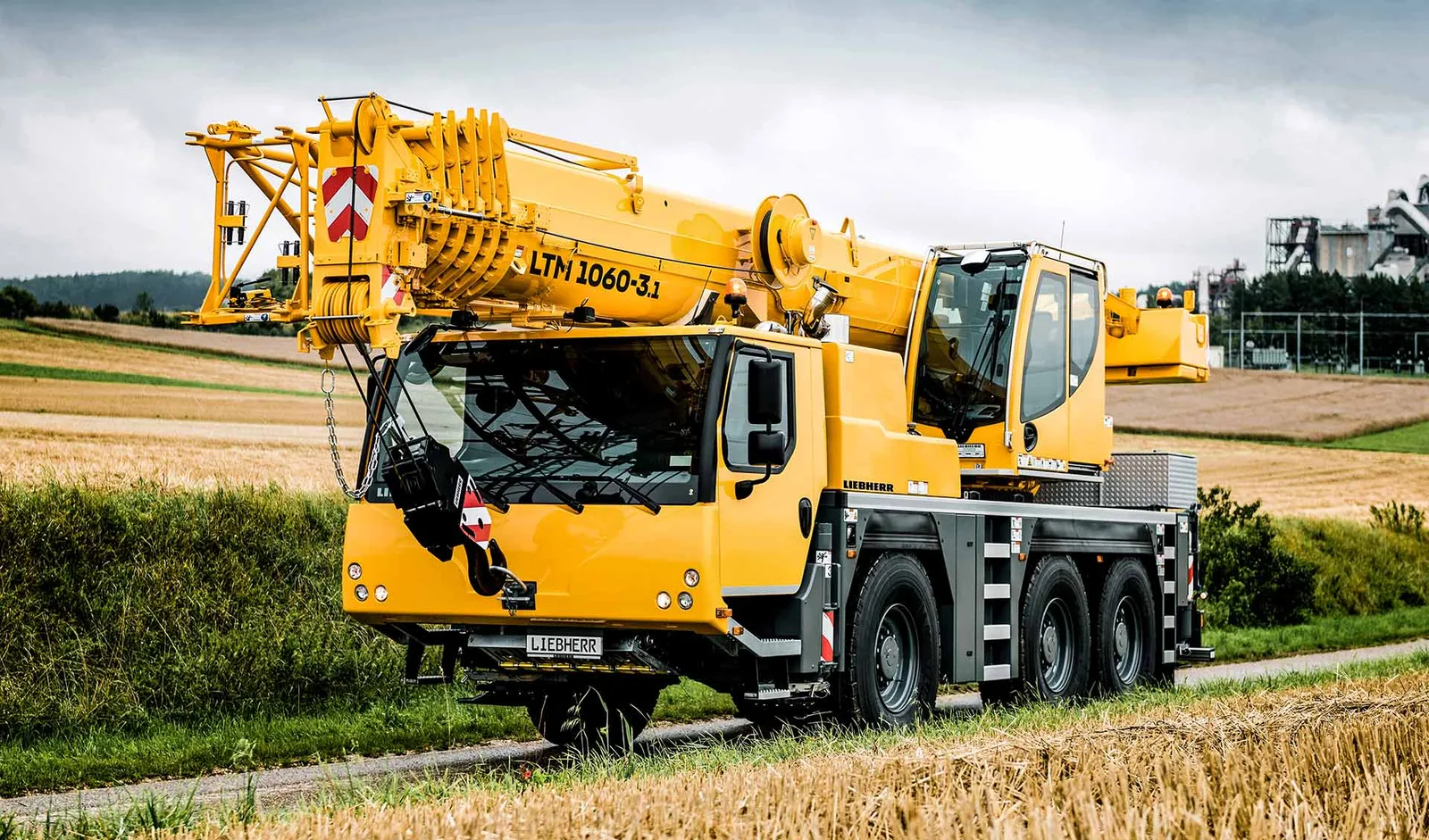
Each outrigger can be extended to any length, not just fixed positions, and the LICCON control calculates the capacity for each situation. Liebherr says the gains are greatest over the outriggers. The variable base is built into the LICCON job planner, so dispatchers can check a reduced-outrigger lift in advance. VarioBase is offered on LTM cranes and is an option on some models, such as the three-axle LTM 1060-3.1. It won the US LLEAP industry award in 2014.
Grove MAXbase
Manitowoc's system for Grove cranes allows asymmetric outrigger set-ups and shows the capacity for the chosen configuration on the CCS control. According to the manufacturer, its four-sector calculation improves charts even with symmetrical outriggers. MAXbase can be retrofitted to earlier cranes with CCS. It is available on Grove All Terrains (including the GMK6450-1), on the GRT8100-1 rough terrain crane – where it adds up to 15 per cent in certain configurations – and on the TMS800-2 truck crane. Manitowoc offers an outrigger pad load calculator and its CRANEbee planning software for lift preparation.
Tadano Smart Chart
Tadano introduced calculation for asymmetric outriggers as early as 1991; in 2017 it became Smart Chart. Tadano describes it as turning the crane's working range from a cone with a circular base into a pyramid with a square one – capacity follows the actual outrigger positions and is higher over the outriggers. In practice that means two things. With full outriggers the crane reaches further without a jib or a larger crane. With asymmetric outriggers it can be set up closer to the load, in a corner of the site, instead of further away at a longer radius.
What it changes on site
- A smaller crane may do. Where one short outrigger once meant ordering the next size up, the same crane is often enough.
- The crane sets up closer. Shorter radius means more capacity on the same chart.
- Slewing needs planning. A load the crane holds over its strong side may be too much over the weak side. The limiter will stop the motion, but the lift plan should account for it beforehand.
- Outrigger loads rise. Working over the strong side puts more load on the nearest outrigger; pads and ground bearing capacity must be checked for the actual configuration.
In short
A variable outrigger base does not make a crane stronger than its rating. It stops losing capacity that used to be thrown away by averaging. Liebherr, Grove and Tadano offer such systems, as do other manufacturers. Names and details differ, but the principle is the same: outrigger extension sensors, capacity calculated by slewing angle, and a load moment limiter watching the weak sectors. For the different mobile crane carriers, see "Choosing a crane by its carrier".
This article is for reference only. Lifts with asymmetric outriggers must be planned with the manufacturer's charts and software for the specific crane.